
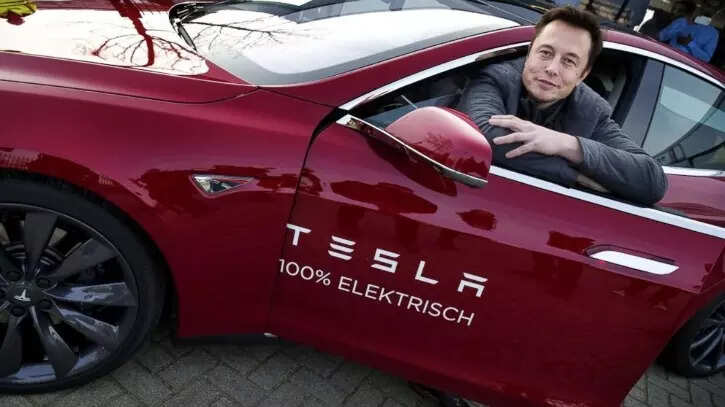
Tesla and SpaceX stocks fall after US midterm election results: Tesla and SpaceX shares came under pressure in premarket trading on Wednesday, November 4, after Democrats won control of both chambers of the US Congress. Tesla fell more than 5%, while SpaceX dropped nearly 8%. While, US stock futures moved sharply higher today.
Dow futures gained nearly 800 points, S&P 500 and Nasdaq futures also posted strong gains. Dow futures were up approximately 801 points. S&P 500 futures had gained 80 points, while Nasdaq 100 futures were higher by 286 points.
Alphabet, Meta and Microsoft traded higher, while Nvidia remained slightly lower. Oracle fell 4.3%. AI infrastructure companies also struggled, with CoreWeave losing around 7%, Iren falling 6% and Nebius declining 3%.
Why did Tesla and SpaceX shares fall after the Democrats’ election victory? Musk had spent more than $400 million supporting Republican candidates during the midterm elections. Around $200 million reportedly went towards political campaigns in Texas, where both Tesla and SpaceX have major operations.
$SPCX – SPACEX, TESLA SLIDE DESPITE MORGAN STANLEY’S BULLISH OUTLOOKSpaceX fell 5% and Tesla dropped 5.6% as Democratic election gains raised concerns over regulatory scrutiny and Elon Musk’s political exposure.Meanwhile, Morgan Stanley raised its SpaceX price target to $300, implying approximately 114% upside from $140.🔸 2027 revenue forecast: $175 billion🔸 2028 revenue forecast: $289 billion🔸 2028 operating income: $119 billion🔸 Free-cash-flow breakeven: 2031, versus 2035 previouslyThe bank sees substantial undervalued potential in SpaceX’s AI operations.
— *Walter Bloomberg (@DeItaone) November 4, 2026 However, Democrats won control of the House and Senate. In Texas, Democratic candidate James Talarico also defeated Republican Ken Paxton in the Senate race. Gina Hinojosa defeated incumbent Governor Greg Abbott, marking the first Democratic victory in a Texas statewide election since 1994.
The results could weaken Musk’s political influence in Washington and Texas. That matters because both companies depend on government decisions, regulatory approvals and public contracts.
President Donald Trump congratulated Democrats after their victories and said he was willing to work with them. However, the change in Congress could make it harder for the administration and Republican lawmakers to advance their plans.
Texas data centre plans could face another hurdle One of the biggest concerns involves Terafab, the semiconductor manufacturing project planned by Tesla and SpaceX in Texas. Musk wants the facility to support the growing demand for advanced chips used in AI systems.
However, Hinojosa has supported tighter rules for new data centre construction. Her proposals include greater community involvement, protections for local water and electricity supplies, and requirements for companies to pay for the infrastructure their projects need.
She has also called for a temporary halt to new data centre construction until lawmakers establish additional rules.
If these proposals move forward, large technology projects could face longer approval processes and higher costs. This would matter to Tesla and SpaceX because both companies are planning major investments in computing infrastructure.
SpaceX faces political risks despite Morgan Stanley’s higher forecasts The fall in SpaceX shares came despite a more positive financial outlook from Morgan Stanley.
The bank has significantly increased its revenue forecasts for the company. It now expects SpaceX to generate $175 billion in revenue in 2027 and $289 billion in 2028.
Its 2028 operating income estimate has also increased by 72% to $119 billion. Morgan Stanley now expects SpaceX to become free-cash-flow positive in 2031, four years earlier than its previous forecast.
The bank has also reduced its estimate of cumulative external borrowing from $670 billion to around $390 billion.
Morgan Stanley has a $300 price target for SpaceX, compared with the roughly $140 share price used in its valuation analysis.
However, these are analyst forecasts, not guaranteed financial results. The company still needs to deliver on its ambitious expansion plans.
Could the Tesla-SpaceX merger face greater regulatory scrutiny? Another concern for investors is the possibility of a Tesla-SpaceX merger.
Musk’s broader vision involves connecting Tesla’s AI and robotics technology with SpaceX’s rockets, satellite network and computing infrastructure. Such a combination could create a much larger business around AI and autonomous technology.
Bloomberg has reported that discussions have focused on potentially announcing a deal in the first half of 2027. However, no completed merger has been announced.
A transaction involving two major companies with extensive government relationships could attract regulatory attention. A less supportive political environment may make the process more complicated.
Tesla has already gained around 34% from its late-July lows, partly on expectations surrounding autonomous driving, robotics and Musk’s wider AI plans.
https://economictimes.indiatimes.com/news/international/us/big-tech-barely-moved-after-the-midterms-but-tesla-and-spacex-fell-up-to-5-and-even-tesla-missed-the-solar-rally-did-elon-musks-big-bet-on-republicans-just-backfire/articleshow/135540520.cms