
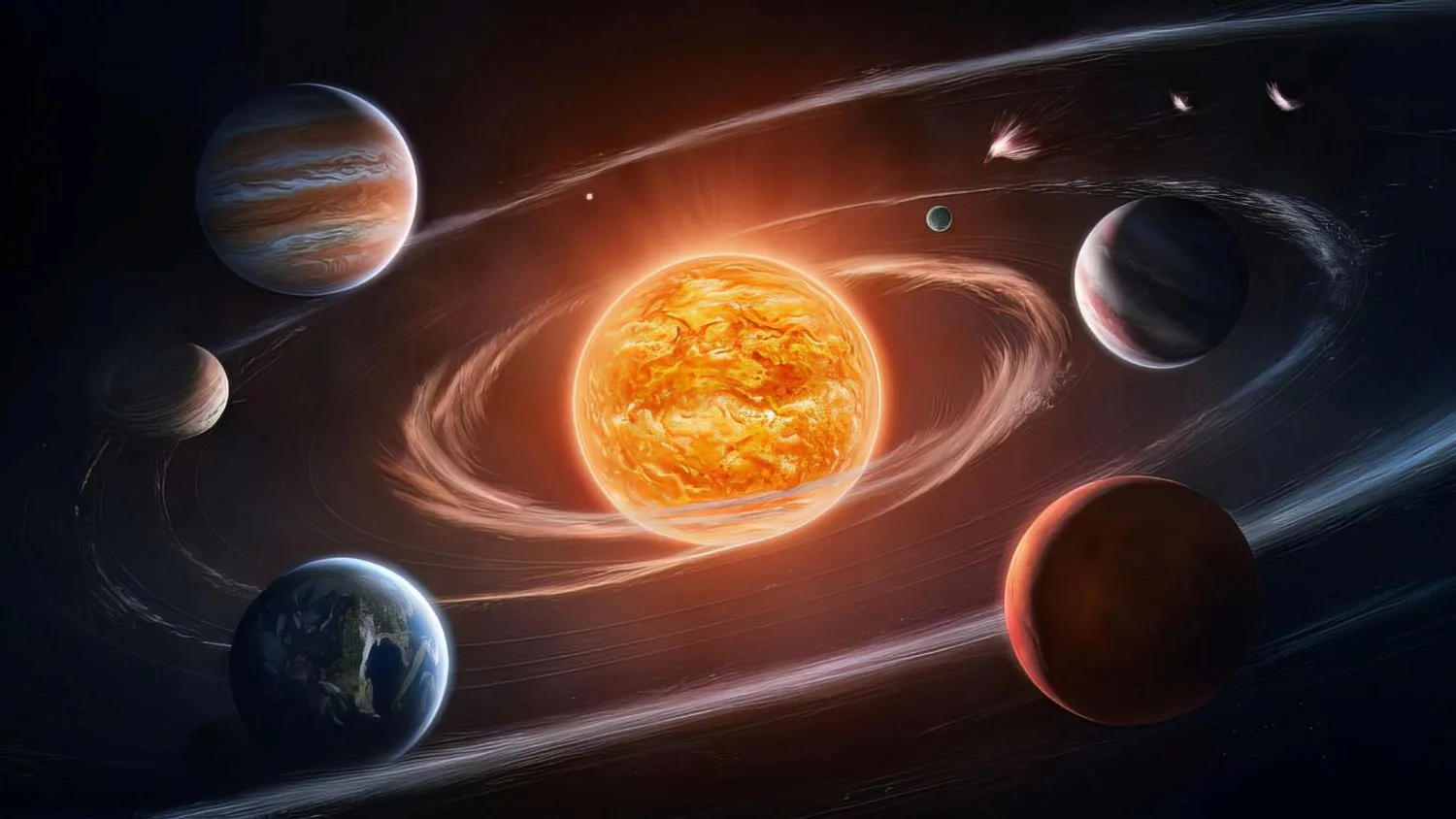
For centuries, astronomers have wrestled with a deceptively simple question: Is our solar system stable? The answer has always seemed reassuring. Yes, Mercury’s orbit carries a small chance of destabilization before the Sun dies. Still, the giant planets- Jupiter, Saturn, Uranus, and Neptune- were thought to be locked into a cosmic dance that could last for nearly forever.
How long does “forever” last? Prior to this work, researchers estimated the outer solar system’s dynamical lifetime at a staggering 10 years. Even when considering that the Sun will eventually lose some of its mass, and other stars may pass near our solar system, the architecture of the giant planets is thought to be able to survive for approximately 100 billion years.
But new research suggests that this comforting picture may be wrong.
Those rosy estimates assumed that when the Sun sheds its mass at the end of its life, it does so smoothly. But recent observations of white dwarf stars, the stellar corpses left behind after stars like our Sun die, show something startling: they recoil. That recoil implies that mass loss isn’t smooth at all. Instead, it happens in discrete, lopsided ejections that act like random kicks to the star’s motion.
If the Sun behaves similarly, then these ripples will move outward and cause the planets to experience unpredictable movements.
First evidence of a dying Sun-like star engulfing an exoplanet
Imagine the Sun shedding its outer layers not as a gentle breeze but as bursts of material flung in different directions. Each burst nudges the Sun slightly, and the planets respond by shifting their orbits. Over time, these nudges add up into a random walk of orbital changes.
Numerical studies indicate that stochastic forces may cause significant changes to the structure of the outer solar system prior to the time when the Sun reaches the end of its life. Orbit crossings are expected to occur at some point during the red giant phase, and approximately 40 percent of the numerical experiments indicated that the outer solar system would experience disruption or extreme scattering before the Sun becomes a white dwarf.
With 3 billion years of the formation of white dwarfs, approximately 90 percent of all systems destroy themselves, reducing the length of time that would have been expected for the outer solar system to exist as long as possible (i.e., forever) to approximately one billion years following the death of our Sun.
A gas giant planet just found to survived the death of its star
A billion years is hard to grasp for humans, but for science, it marks a big shift. This tells us the outer Solar System is not the forever-running machine we thought it was; instead, it is very fragile and can be affected by the Sun’s last breaths.
This suggests that as we consider other planetary systems throughout the universe, our understanding of them will change. If “asymmetric mass loss” happens often, the amount of time that stable conditions exist in exoplanetary systems may be much less than what we thought before. The calm orbits that we are seeing today could simply be a short-term situation; they are likely to become chaotic as the star that they revolve around dies.
Celestial mechanics has historically been a balancing act between the order of a system and the chaos within it. While the potential for instability in the orbits of the inner planets may be slight, it does exist. The recent evidence, however, indicates that the destiny of the outer planets will depend upon the Sun’s final moments.
In other words, the solar system’s stability isn’t forever; it’s conditional. And the ticking clock is shorter than we imagined.
Journal Reference:
Konstantin Batygin, Jim Fuller, and Fred C. Adams. Terminal Instability of the Solar System Triggered by Stochastic Solar Mass Loss. The Astrophysical Journal Letters. DOI 10.3847/2041-8213/aea290
https://www.techexplorist.com/new-calculation-rewrite-solar-systems-ultimate-fate/105725/