

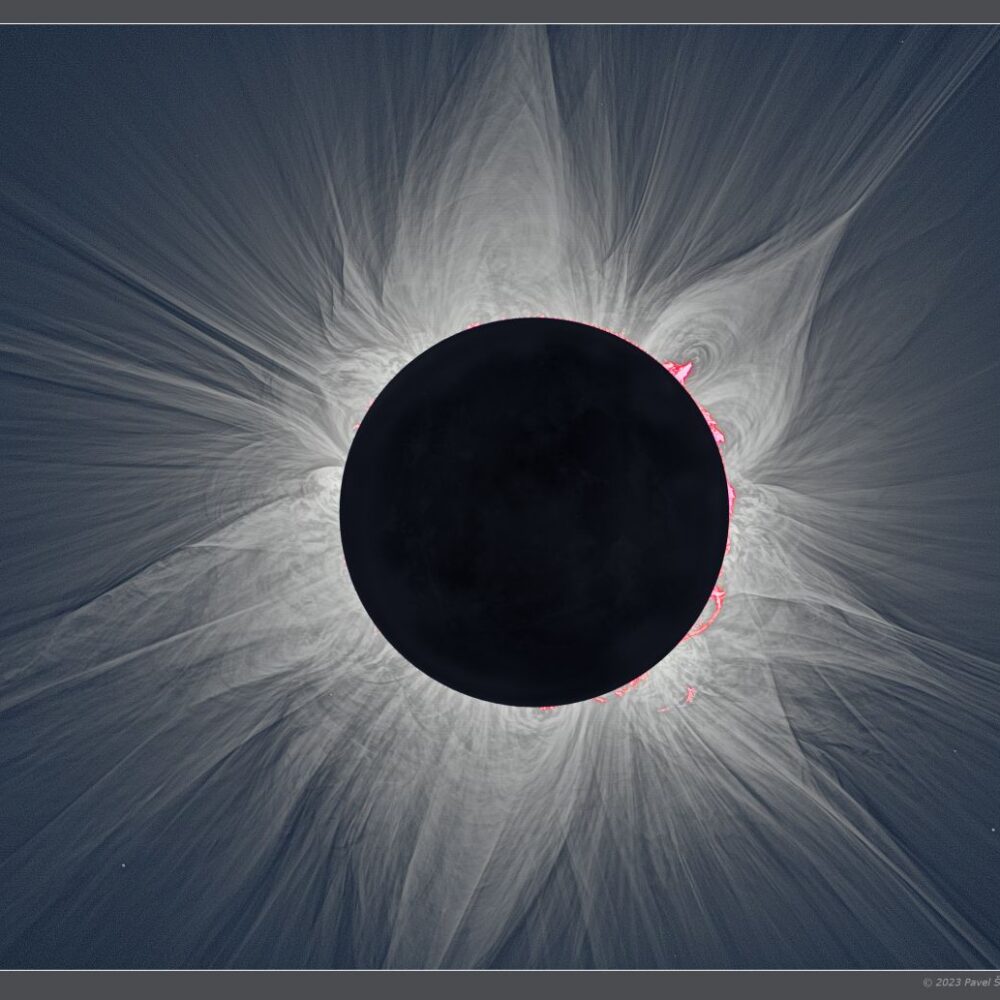
The study of the solar corona has significant implications for understanding and forecasting space weather phenomena. Yet, regardless of scientific breakthroughs brought by space-based coronagraphs, access to the lowest layers of the Suns atmosphere remains possible mostly during rare total solar eclipses on Earth.
What if we could summon a solar eclipse whenever we wanted, not from Earth, but from space?
Thats the bold vision behind the Moon-Enabled Sun Occultation Mission (MESOM), a UK-led project unveiled at the Royal Astronomical Societys National Astronomy Meeting 2025 in Durham.
Researchers from the Mullard Space Science Laboratory at University College London (UCL), Aberystwyth University, and the Surrey Space Centre, part of the University of Surrey, are behind this new plan.
The mission aims to create artificial solar eclipses in orbit using a mini-satellite and the Moons shadow, unlocking the Suns most mysterious secrets far more often than nature allows.
If approved, MESOM could operate for two years and produce the equivalent of 80 solar eclipses, far more than we could ever observe from Earth. This would give scientists a rare chance to study the Suns atmosphere in detail and learn more about how space weather begins.
The same total solar eclipse with the fields of view of the MESOM instruments superimposed on top of it (i.e. HiBri,LoBri, CHILS and Mag-CHILS).
Miloslav Druckmuller, Shadia Habbal, Pavel Starha
To do this, MESOM would send a small satellite into a special orbit that lines up with the Moons shadow about once every 29.6 days, the same length as a lunar month.
MESOM would recreate total solar eclipses in space, lasting up to 48 minutes, about 10 times longer than those seen from Earth. And because its outside Earths atmosphere, the satellite could collect much clearer data.
Dr. Nicola Baresi from the Surrey Space Centre explained that MESOM cleverly uses the natural motion of the Sun, Earth, and Moon to create these eclipse conditions in space, with the Moon acting like a natural blocker of sunlight.
The missions main goal is to study the Suns inner corona, the mysterious, super-hot layer that plays a key role in solar storms and space weather. This region is hard to observe because its only visible during eclipses.
Thanks to its smart orbit, MESOM would pass through the darkest part of the Moons shadow, called the umbral cone, about once every lunar month, giving scientists regular, extended eclipse views from space.
MESOM would let scientists see closer to the Sun than ever before. For comparison, ESAs current Proba-3 mission observes the Suns outer atmosphere (the corona) from about 765,000 km away. MESOM would get even closer, down to 710,000 km, which is 56,000 km nearer to the Sun.
To make the most of this close-up view, MESOM would carry several advanced instruments:
A high-resolution coronal imager (like a powerful camera) to take detailed pictures of the Suns atmosphere, led by the US Naval Research Lab.
A coronal mass spectrometer, developed by Aberystwyth University and UCL, to study what the Suns plasma is made of and how it behaves.
A spectropolarimeter, from the Spanish Space Solar Physics Consortium, to examine the Suns magnetic field and track solar activity like flares and sunspots
Dr. Baresi said, “When the Sun is near the orbital plane of the Moon, we can experience total eclipses as long as 48 minutes, which would enable unprecedented and prolonged measurements of physical processes from which adverse space weather events, namely solar flares and coronal mass ejections, may originate.”
The team submitted MESOM to ESA’s F-class mission call in May 2025 and expects a response later this year. If selected, it could be launched between 2026 and 2028.
F-class missions are designed to be smaller, faster, and more cost-effective than ESA’s larger “M-class” missions, with a ceiling cost of 205 million (175 million) and a development timeline of less than eight years from selection to launch.
https://www.techexplorist.com/artificial-solar-eclipses-new-way-understand-sun/100153/#utm_source=rss&utm_medium=rss&utm_campaign=artificial-solar-eclipses-new-way-understand-sun