
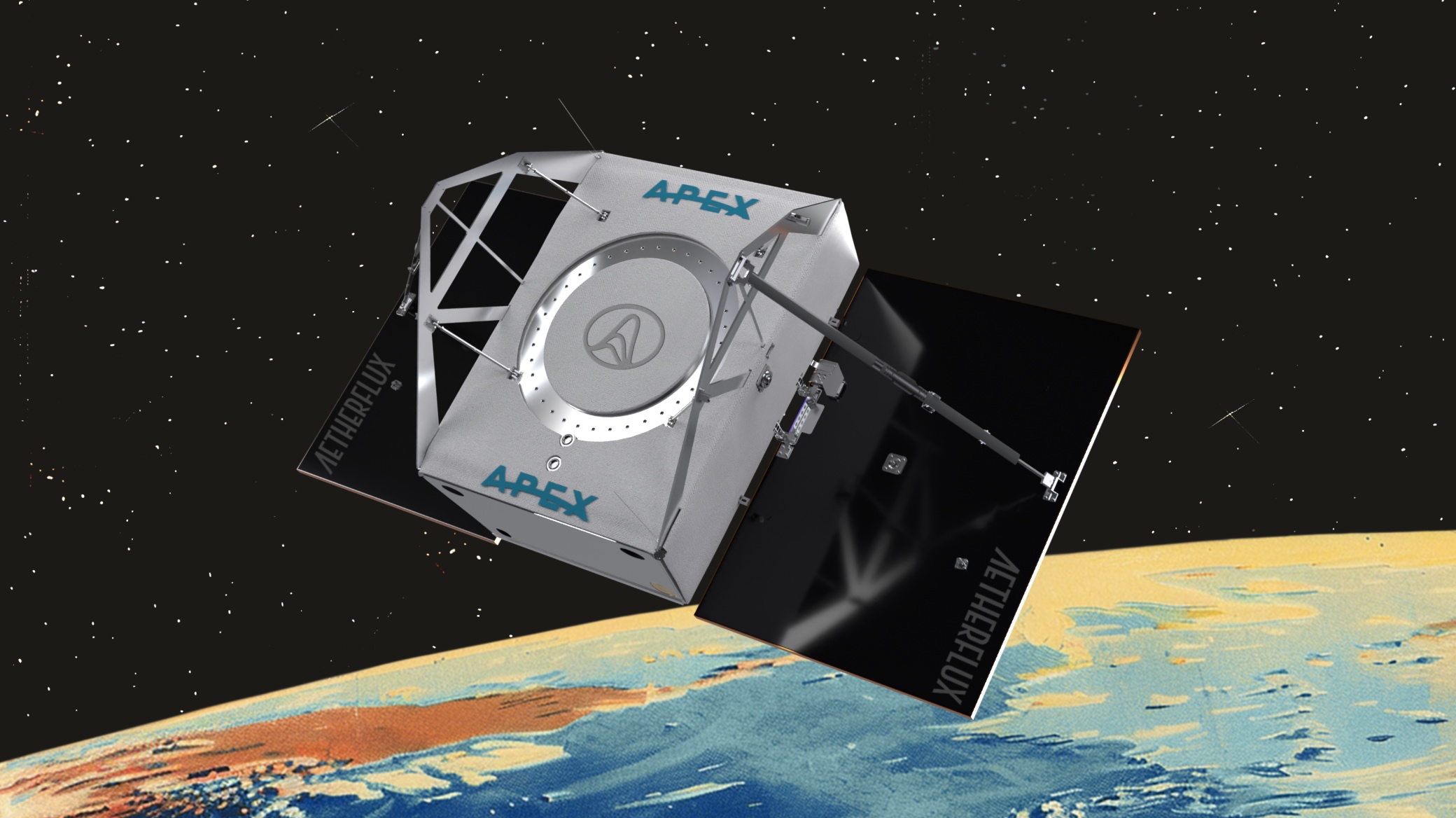
Aetherflux plans to launch an initial demonstration satellite to test its space-based solar power technologies by 2026. Credit: Aetherflux
TAMPA, Fla. Space-based solar power startup Aetherflux has thrown its hat into the emerging market for orbital data centers, joining SpaceX, Amazon and others exploring ways to move energy-hungry artificial intelligence compute off Earth.
Aetherflux announced plans Dec. 9 to deploy its first low Earth orbit (LEO) Galactic Brain data center node in the first quarter of 2027, with thousands of proposed satellites slated to follow to improve performance.
The California-based venture provided few details about the plan or performance, describing the spacecraft as its first commercially viable orbital compute node that would leverage continuous solar power and radiative cooling to support high-density processing in space.
According to an Aetherflux spokesperson, the node would leverage optical inter-satellite links and emerging relay networks to support continuous availability that is comparable to terrestrial servers for these applications.
This is a direct application of our foundational technologies, the Aetherflux spokesperson said via email.
Our core work on space-based laser systems, precision targeting and high-efficiency power management are the building blocks for this infrastructure. Orbital compute and power beaming are two sides of the same coin. A robust, space-based energy ecosystem.
Next year, Aetherflux plans to deploy a small satellite from Californias Apex, designed to wirelessly beam energy from LEO to the ground using infrared lasers.
The approach departs from traditional space-based solar power (SBSP) concepts centered on massive geostationary platforms transmitting energy via microwaves.
In April, Aetherflux raised a $50 million Series A venture funding round to support the SBSP constellation, which it says is attracting early military interest in supplying energy to remote or contested environments. The Department of Defense has awarded the venture funds for a proof-of-concept demonstration of power transmission from LEO.
The race for artificial general intelligence is fundamentally a race for compute capacity, and by extension, energy, said Aetherflux founder and CEO Baiju Bhatt, who also co-founded financial services app Robinhood.
The elephant in the room is that our current energy plans simply wont get us
there fast enough. Galactic Brain puts the sunlight next to the silicon and skips the power grid entirely.
Above the cloud computers
Aetherfluxs announcement comes amid a broader push toward orbital compute to overcome terrestrial power constraints and AIs soaring energy demands.
U.S. startup Starcloud recently launched a small satellite carrying an Nvidia processor to run AI models in orbit, while China has begun deploying a proposed 2,800-satellite for large-scale orbital compute.
SpaceX CEO Elon Musk has said upcoming Starlink V3 satellites could be scaled into orbiting data centers, once Starship is operational, while Amazons Jeff Bezos recently predicted gigawatt-scale data centers will be deployed in space within the next decade or two.
Jason Rainbow writes about satellite telecom, finance and commercial markets for SpaceNews. He has spent more than a decade covering the global space industry as a business journalist. Previously, he was Group Editor-in-Chief for Finance Information Group,…
More by Jason Rainbow
Post navigation
https://spacenews.com/space-based-solar-power-startup-aetherflux-enters-orbital-data-center-race/