
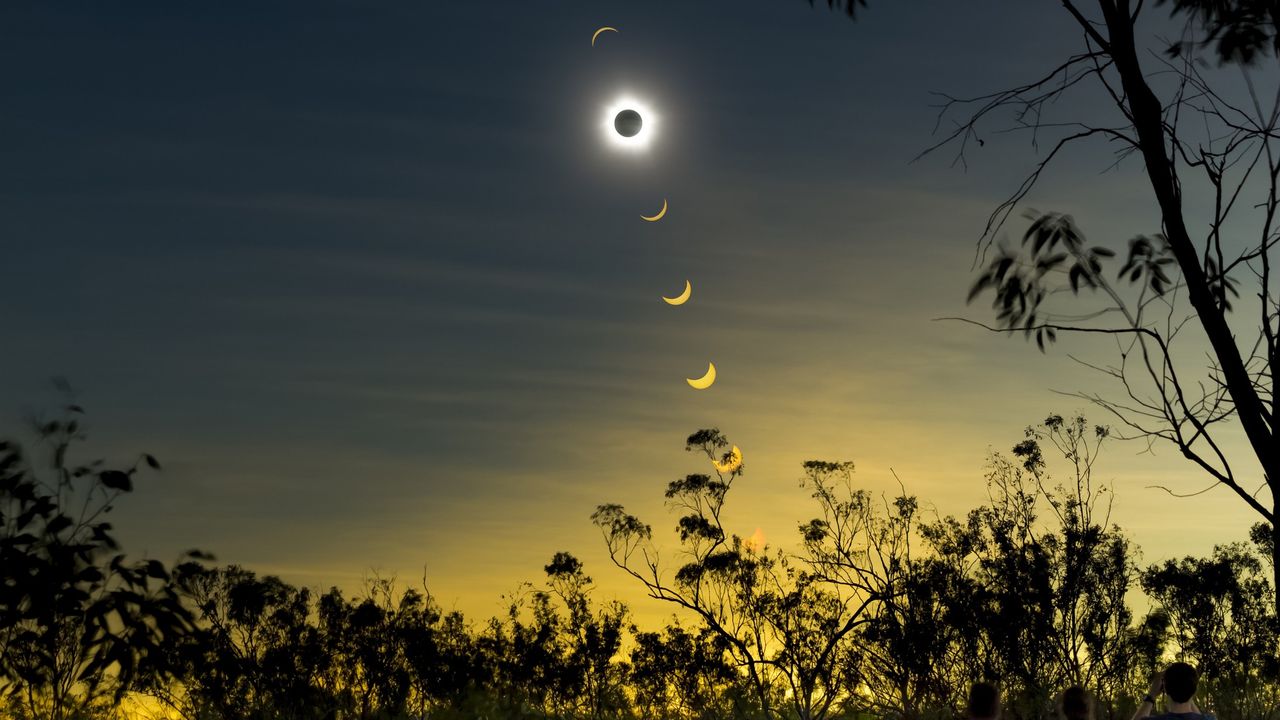
The Australian Outback will experience a long totality in 2028.
(Image credit: Philip Hart/Stocktrek Images via Getty Images)
On July 22, 2028, the moon’s shadow will cut a 143-mile-wide (230 kilometer) path across Australia and New Zealand. According to NASA , it will mark the first total solar eclipse visible from Sydney since 1857 and the last until 2858, making it a once-in-a-lifetime event for the city’s 5 million residents.
Sydney’s Opera House and Harbour Bridge will form a spectacular backdrop and grab the headlines before and after the event. However, eclipse chasers will likely head far to the northwest to the remote Kimberley region and the Australian Outback, where probable cloud-free winter skies promise over five minutes of totality. Meanwhile, New Zealand’s South Island will catch the final act of the eclipse close to sunset.
Related: What’s the difference between a total solar eclipse and an annular solar eclipse?
What’s special about the July 22, 2028, total solar eclipse? This eclipse will feature a long totality over some iconic locations, including Sydney Harbour, as well as the Bungle Bungles and Karlu Karlu (Devil’s Marbles) in the Australian Outback. Sydney will attract the media attention and crowds, but the remote regions will have the highest chance of clear skies. Add Cocos Islands and Christmas Island, and there’s something for every kind of eclipse chaser, whether they’re looking to experience it with others or in lonelier surroundings.
The Bungle Bungles in Purnululu National Park, Western Australia, will experience totality. (Image credit: Francesco Riccardo Iacomino via Getty Images) For those bound for the Outback, there’s also the promise of dark skies and views of the Milky Way ‘s core. There, Kununurra, Western Australia, and Alice Springs, Northern Territory, will be the logical bases. Get there a week before the eclipse if you want to make the best of dark skies, although the Delta Aquariid meteor shower peaks a week after the eclipse.
Path of totality for the total solar eclipse 2028 The totality phase whereby the moon blocks the entirety of the sun’s disk is only visible when viewed from within the path of totality. (Image credit: Created using MapHub.net. Source: Esri, Maxar, GeoEye, Earthstar Geographics, CNES/Airbus DS, USDA, USGS, AeroGRID, IGN, and the GIS user community) The eclipse path for the July 22, 2028, total solar eclipse spans 7,442 miles (11,976 km). The eclipse will begin at sunrise in the Indian Ocean; pass over the Cocos and Christmas islands; sweep across Western Australia, the Northern Territory, Queensland and New South Wales; and then finally cross the Tasman Sea to New Zealand.
The eclipse will last 2 hours, 49 minutes from first landfall to final contact, with a maximum totality of 5 minutes, 10 seconds occurring near the Drysdale River in Western Australia. About 6.3 million people live in the path of totality, according to Time and Date , with the vast majority residing in Sydney and its suburbs.
Breaking space news, the latest updates on rocket launches, skywatching events and more!
Totality will visit Karlu Karlu/Devils Marbles Conservation Reserve in Northern Territory, Australia, on July 22, 2028. (Image credit: John White Photos via Getty Images) Where and when can I see the July 22, 2028 total solar eclipse? Swipe to scroll horizontally
Here are some of the places eclipse chasers will gather for the total solar eclipse on July 22, 2028: Location
Totality duration
Time
Sun height
Direction Island, Cocos Islands
3 minutes, 26 seconds
8:12 a.m. CCT
23.4 degrees northeast
South Point, Christmas Island
4 minutes, 5 seconds
8:54 a.m. CXT
34.3 degrees northeast
Scott Reef, Indian Ocean
4 minutes, 48 seconds
9:37 a.m. AWST
50.8 degrees northeast
Lamarck Island, Australia
5 minutes, 8 seconds
10:47 a.m. AWST
52.2 degrees northeast
Wyndham, Australia
3 minutes, 20 seconds
10:57 a.m. AWST
53.2 degrees northeast
Bungle Bungles, Australia
3 minutes, 18 seconds
11:00 a.m. AWST
51.5 degrees northeast
Kununurra, Australia
2 minutes, 50 seconds
10:59 a.m. AWST
53.2 degrees northeast
Karlu Karlu, Australia
4 minutes, 50 seconds
12:48 p.m. ACST
49.2 degrees northeast
Siding Spring Observatory, Coonabarabran, Australia
1 minute, 47 seconds
1:56 p.m. AEST
32.5 degrees northeast
Dubbo, Australia
3 minutes, 46 seconds
1:55 p.m. AEST
32 degrees northeast
Sydney, Australia
3 minutes, 44 seconds
1:59 p.m. AEST
29.1 degrees northeast
What will the weather be like for the total solar eclipse? There’s a saying among eclipse chasers: “The climate is what you expect; the weather is what you get.” While you can maximize your chances of finding a clear sky if you’re mobile, you can also choose to visit the Outback, where clouds are less likely. According to Time and Date, Kununurra has had a cloudy day on July 22 about 11% of the time since 2000, compared with 10% for the Bungle Bungles and 23% for Karlu Karlu. Expect the one-lane roads in the Outback to be VERY busy.
The riskiest regions for clouds are, as usual, near the coast, with the highest chance of clouds being on Cocos Island (65%), Christmas Island (57%) and, annoyingly, Sydney (47%). This eclipse takes place in the Southern Hemisphere’s winter.
A timelapse of cloud cover on the path of the 2028 total solar eclipse from July 8 to Aug. 7, 2023. (Image credit: NASA Worldview application https://worldview.earthdata.nasa.gov) Where to see the partial solar eclipse on July 22, 2028 A partial solar eclipse will be visible across Australia, New Zealand and Southeast Asia on July 22, 2028.
Swipe to scroll horizontally
What will be seen from major cities and destinations in the partial eclipse zone: Location
Percentage of the sun’s disk covered
Alice Springs, Australia
95%
Broome, Australia
91%
Jakarta, Indonesia
89%
Darwin, Australia
88%
Wellington, New Zealand
83%
Brisbane, Australia
81%
Melbourne, Australia
81%
Adelaide, Australia
76%
Hobart, Tasmania, Australia
73%
Singapore
60%
Kuala Lumpur, Malaysia
52%
Perth, Australia
50%
Ho Chi Minh City, Vietnam
27%
Phnom Penh, Cambodia
24%
Bangkok, Thailand
16%
Manila, Philippines
13%
After July 22, 2028, when is the next total solar eclipse? After the total solar eclipse on July 22, 2028, these are the dates and locations for the next total solar eclipses:
Nov. 25, 2030 : Namibia, Botswana, South Africa, Lesotho and Australia Nov. 14, 2031 : Pacific Ocean (totality) and Panama (annularity) March 30, 2033 : Russia and the U.S. (Alaska) March 20, 2034 : Benin, Nigeria, Cameroon, Chad, Sudan, Egypt, Saudi Arabia, Kuwait, Iran, Afghanistan, Pakistan, India and China Sept. 2, 2035 : China, North Korea and Japan July 13, 2037 : Australia Dec. 26, 2038 : Australia and New Zealand Additional resources You can find a concise summary of solar eclipses out to 2030 on NASA’s eclipse website . Read more about solar and lunar eclipses on EclipseWise.com , a website dedicated to predictions of eclipses, and find beautiful maps on eclipse cartographer Michael Zeiler’s EclipseAtlas.com and interactive Google Maps on Xavier Jubier’s eclipse website and Timeanddate.com’s Eclipse Central hub. You can find climate and weather predictions by meteorologist Jay Anderson on Eclipsophile.com and advice on photography from expert eclipse photographer Alan Dyer at AmazingSky.com .
Bibliography Bakich, M. and Zeiler, M. (2022). Atlas Of Solar Eclipses 2020-2045.
https://www.greatamericaneclipse.com/books/atlas-of-solar-eclipses-2020-to-2045
Jubier, X. (n.d.). Solar eclipses: Interactive Google Maps. Retrieved Jun. 24, 2025, from http://xjubier.free.fr/en/site_pages/SolarEclipsesGoogleMaps.html
NASA Worldview application, part of the NASA Earth Science Data and Information System (ESDIS). Retrieved Jun. 24, 2025 from https://worldview.earthdata.nasa.gov
Time and Date. (n.d.). July 22, 2028 Total Solar Eclipse. Retrieved Jun. 24, 2025, from https://www.timeanddate.com/eclipse/solar/2028-july-22
Join our Space Forums to keep talking space on the latest missions, night sky and more! And if you have a news tip, correction or comment, let us know at: community@space.com.
Jamie is an experienced science, technology and travel journalist and stargazer who writes about exploring the night sky, solar and lunar eclipses, moon-gazing, astro-travel, astronomy and space exploration. He is the editor of WhenIsTheNextEclipse.com and author of A Stargazing Program For Beginners , and is a senior contributor at Forbes. His special skill is turning tech-babble into plain English.
https://www.space.com/stargazing/solar-eclipses/total-solar-eclipse-2028-everything-you-need-to-know-about-totality-in-australia-and-new-zealand