

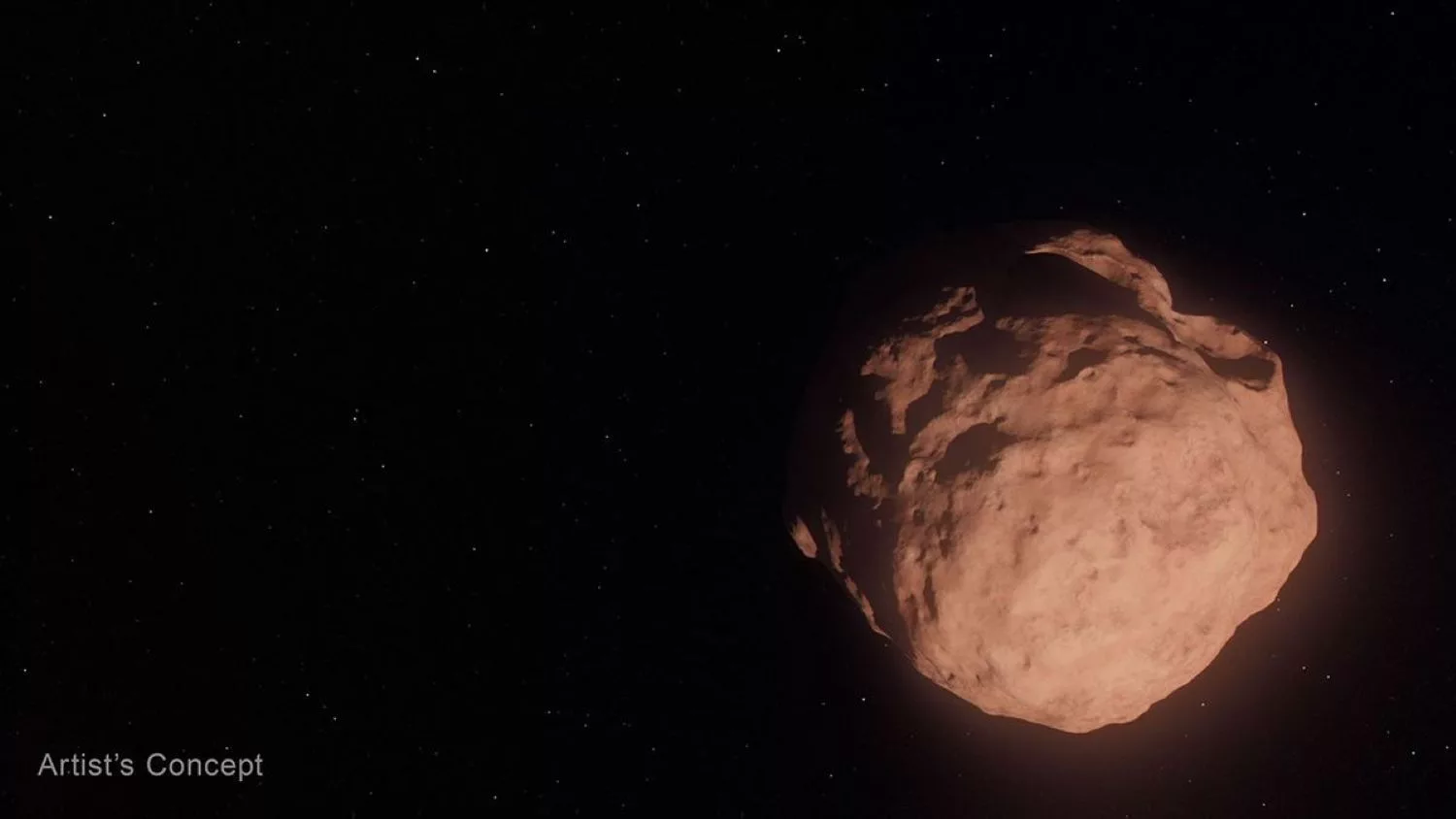
Beyond Neptune, there is a region consisting of icy worlds which are so faint and remote that even the most powerful telescopes have difficulty observing them. The Trans-Neptunian Objects (TNOs) are relics from the very beginning of the solar system: frozen planetesimals that never developed into full-blown planets.
Now, for the first time, scientists have combined the strengths of NASA’s Hubble Space Telescope and the James Webb Space Telescope to study some of the smallest and dimmest TNOs ever detected.
The results, published in The Astronomical Journal, reveal a mystery. There are fewer tiny TNOs than expected, and their colors suggest they have preserved their primordial surfaces far better than models predicted.
The TNOs are more than 100 million times fainter than the limit of human eye visibility. They are nevertheless valuable to planetary scientists because they are the incomplete building blocks of planets. In the early solar system, dust and pebbles combined to form planetesimals the size of cities. Near the Sun, these planetesimals merged to become planets. However, beyond Neptune the process came to a halt and a population of small, frozen worlds remained.
Astronomers spotted 461 trans-Neptunian objects in our solar system
By studying these bodies, researchers can glimpse the conditions of planet formation 4.5 billion years ago.
Two teams, led by PhD candidates Marielle Eduardo (University of Victoria) and Anastasia Morgan (Northern Arizona University), coordinated simultaneous observations with Hubble and Webb.
The Hubble telescope recorded visible light while the Webb telescope measured infrared signatures. The two telescopes then examined the colors, compositions, sizes, and orbits of 27 newly discovered TNOs, some of which were as small as 5 kilometers across- objects that are beyond the range of ground-based telescopes.
One object was so faint that detecting it was compared to spotting a swarm of fireflies on the Moon from Earth.
The survey distinguished between two populations of transNeptunian objects (TNOs). Cold TNOs remain on their original, relatively circular orbits within the solar system’s plane, preserving a record of primordial conditions. In contrast, hot TNOs were born between Uranus and Neptune but were later scattered outward into eccentric, tilted orbits during the early migration of the giant planets.
What the astronomers had expected was to see evidence of surface alteration in the smaller TNOs due to having suffered numerous collisions. Instead, the smallest bodies were just like their larger cousins. They showed the same color relationships as the bigger TNOs, which means that collisions must occur less frequently than was previously thought or that the bodies retain their original compositions in some way.
Mystery orbits in outermost reaches of solar system not caused by Planet Nine, study
As Morgan explained: “It’s fascinating to see that the smallest objects are somehow ‘remembering’ and preserving the history of how they were made.”
Webb’s infrared sensitivity also allowed the team to measure the size distribution of these tiny worlds. Both hot and cold populations showed remarkably similar distributions, despite forming in different regions of the solar system.
Eduardo noted: “The process of planetesimal formation ends up producing the same distribution of sizes for both cold and hot populations, despite forming in different regions. The process seems to be insensitive to disk conditions.”
Once again, a surprise appeared: the number of small TNOs was less than that predicted by some models. This suggests that the early solar system may have formed with fewer tiny planetesimals than was expected, or that many of them have since been destroyed.
The Discovery of CO2 and CO Ices in the Outer Solar System
This changes our view of the frontier of the solar system and indicates that collisions might not have been the main factor in the evolution of trans-Neptunian objects (TNOs) as was previously believed.
Instead, these bodies retain their original colors, which are primordial and thus provide useful clues about where they formed. Furthermore, the universal size distributions show that planetesimal formation follows firm rules and is largely independent of local conditions.
And critically, this work demonstrates the unique power of Hubble and Webb working together. Neither telescope alone could have achieved these results, but together they opened a new window into the frozen remnants of planet formation.
The team published two complementary papers in The Astronomical Journal.
https://www.techexplorist.com/solar-system-objects-still-remember-were-born/104203/