

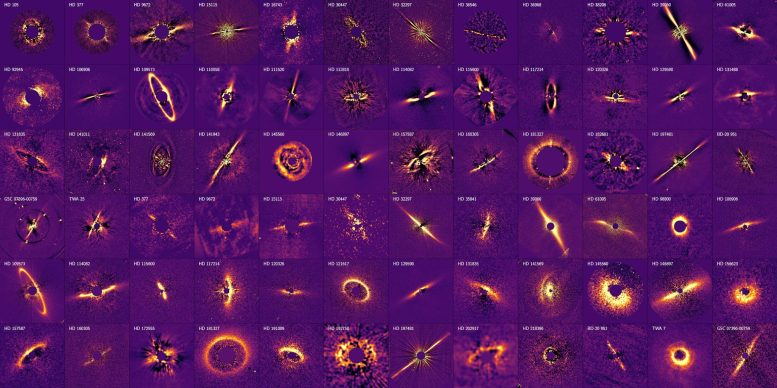
This image presents a grid of color-enhanced astronomical observations, each depicting a circumstellar disc—structures of dust and gas surrounding stars. Every square in the grid represents a different star system, identified by catalogue names such as “HD 105”, “HD 377”, or “TWA 25”. The discs vary widely in shape, size, and orientation: some appear as well-defined rings, while others show elongated or irregular forms. The colour palette, dominated by purples and oranges, highlights brightness and contrast to reveal structural details. This visual diversity reflects different physical properties and evolutionary stages of the star systems, offering valuable insights into planetary formation and stellar development. Credit: N. Engler et al./SPHERE Consortium/ESO
New high-contrast images from SPHERE show a stunning variety of debris disks shaped by collisions of tiny planet-building bodies. The structures often resemble our asteroid and Kuiper belts, hinting at unseen giant planets sculpting the dust.
By comparing 51 systems, astronomers found clear trends linking star mass to disk mass and size. These images lay the groundwork for future telescopes to uncover the planets responsible for these patterns.
SPHERE Reveals Debris Disks Around Distant Stars
Using the SPHERE instrument on ESO’s Very Large Telescope, astronomers have assembled an unprecedented set of images of debris disks in distant planetary systems. These are wide, dusty structures made of tiny particles that orbit other stars and trace the presence of unseen small bodies.
Gaël Chauvin (Max Planck Institute for Astronomy), project scientist for SPHERE and co-author of the study, explains: “This data set is an astronomical treasure. It provides exceptional insights into the properties of debris disks, and allows for deductions of smaller bodies like asteroids and comets in these systems, which are impossible to observe directly.”
Small Bodies in Our Own Solar System
To understand why this is so important, it helps to look at our own cosmic neighborhood. Beyond the Sun, the planets, and dwarf planets such as Pluto, our solar system is crowded with smaller (“minor”) bodies. Among these, astronomers are especially interested in objects that span from about a kilometer to several hundred kilometers in size. When such an object occasionally sheds gas and dust and develops a visible tail, we describe it as a comet. When it does not, we call it an asteroid.
These small bodies are time capsules. They preserve clues to the early stages of the solar system’s history, when tiny dust grains gradually grew into larger and larger objects. In this growth process, bodies known as planetesimals represent an intermediate step between dust and full-fledged planets. Asteroids and comets are leftover planetesimals that never grew into larger planets. In that sense, small bodies are (somewhat) modified remnants of the raw material that once built worlds like Earth.
ESO’s Very Large Telescope is composed of four Unit Telescopes (UTs) and four Auxiliary Telescopes (ATs). Seen here is one of the UTs firing four lasers, which are crucial to the telescope’s adaptive optics systems. To the right of the UT are two ATs, these smaller telescopes are moveable and work in tandem with the other telescopes to create a unique and powerful tool for observing the Universe. Credit: ESO/A. Ghizzi Panizza
Small Bodies Around Other Stars
Astronomers have now identified more than 6,000 exoplanets (that is, planets orbiting stars other than the Sun), revealing a remarkable variety of planetary systems and helping us place our own solar system in context. Actually taking pictures of these distant planets, however, is extremely difficult. Fewer than 100 exoplanets have been directly imaged so far, and even the largest ones usually appear as simple, featureless points of light.
“Finding any direct clues about the small bodies in a distant planetary system from images seems downright impossible. The other indirect methods used to detect exoplanets are no help, either,” says Dr Julien Milli, astronomer at the University Grenoble Alpes and co-author of the study.
Dust From Planetesimal Collisions as a Tracer
The key, somewhat surprisingly, lies in material that is much smaller than the small bodies themselves. In young planetary systems, planetesimals frequently collide. Sometimes they merge to form a larger body, and sometimes they fragment and fly apart. These impacts release huge amounts of fresh dust.
With the right instruments, this dust can be detected from very far away. The physics is straightforward: if you break an object into many smaller pieces, its total volume stays the same, but the combined surface area increases dramatically. If you start with an asteroid one kilometer wide and break it into dust grains only one micrometer across (= millionth of a meter), the total surface area grows by a factor of a billion. Because there is so much more surface to scatter starlight, the resulting dust cloud is much easier to see. By observing the light reflected by this dust, astronomers can infer the presence and properties of the small bodies that produced it. This is how debris disks around young stars become powerful tracers of hidden planetesimals.
Debris Disk Evolution and Our Solar System’s Belts
As time passes, a debris disk does not remain static. Collisions become less common, and the dust gradually disappears. Some grains are pushed out of the system by radiation pressure from the central star. Others are swept up by planets or planetesimals, or spiral inward and eventually fall into the star itself.
Our solar system shows what remains after billions of years of evolution. Today, two major planetesimal belts survive. One is the asteroid belt between Mars and Jupiter. The other is a vast store of comets beyond the giant planets in a region called the Kuiper belt. In addition, there is a population of dust within the plane of the solar system’s orbits, known as zodiacal dust. On very dark nights, you can see sunlight reflected by this dust shortly after sunset or before sunrise as a faint glow along the ecliptic, called zodiacal light.
For an alien civilization observing from far away, this mature configuration would be hard to detect. In contrast, the new study shows that, for relatively nearby systems, the dusty phase in a debris disk’s first roughly 50 million years should be visible with the best modern telescopes and instruments. That does not mean the task is easy. Imaging a debris disk is comparable to photographing a faint puff of cigarette smoke hovering next to a powerful stadium floodlight, while you are standing several kilometers away. In this demanding context, specialized instruments are essential, and SPHERE, which began operations on one of ESO’s Very Large Telescopes (VLT) in early 2014, is designed precisely for this challenge.
How SPHERE Blocks Starlight and Sharpens the View
The central idea behind SPHERE can be understood from everyday experience. If the Sun is shining directly into your eyes, you might raise your hand to block the glare so you can see the surrounding scene. SPHERE does something similar when it observes an exoplanet or a debris disk. It uses a coronagraph to block out most of the star’s light, inserting a small disk into the optical path that removes the bright central glare before the image is recorded. This seemingly simple approach only works if the imaging is extremely stable and precise.
To achieve the necessary performance, SPHERE uses an advanced form of adaptive optics. Light from distant stars is distorted as it passes through Earth’s turbulent atmosphere. SPHERE continuously analyzes these distortions and corrects them in real time using a deformable mirror, which reshapes itself many times per second. An additional optional component of SPHERE isolates light with specific properties (“polarized light”) that are characteristic of light scattered by dust grains rather than originating directly from the star. This filtering provides an extra boost in sensitivity for debris disk imaging.
A Deep Survey of Debris Disks Around Young Stars
The new study showcases a unique collection of debris disk images created with SPHERE by observing starlight reflected from tiny dust particles in these systems.
“To obtain this collection, we processed data from observations of 161 nearby young stars whose infrared emission strongly indicates the presence of a debris disk,” says Natalia Engler (ETH Zurich), the lead author of the study. “The resulting images show 51 debris disks with a variety of properties — some smaller, some larger, some seen from the side and some nearly face-on – and a considerable diversity of disk structures. Four of the disks had never been imaged before.”
Working with such a large and homogeneous sample is crucial for identifying patterns in how debris disks and their host stars behave. In this case, analyzing the 51 disks and their stellar properties revealed clear trends. More massive young stars tend to host more massive debris disks. Disks where most of the dust and material reside farther from the star also tend to be more massive.
As the largest optical telescope in the world, the ELT will allow scientists to dive further into our universe than ever before. The ELT’s 39-meter ‘eye on the sky’ will capture some of the clearest images ever taken, with a precision reaching 16 times that of the Hubble Space Telescope. Credit: ESO
Tracing Asteroid Belts and Kuiper Belts in Other Planetary Systems
One of the most intriguing aspects of the SPHERE images lies in the internal structures of the disks. Many of them display ring-like or banded patterns, with material concentrated at particular distances from the central star. This arrangement closely resembles what we see in our solar system, where small bodies are grouped in the asteroid belt (asteroids) and in the Kuiper belt (comets).
These ring and belt features are widely thought to be shaped by planets, especially giant ones, that clear paths in the surrounding material. Some of the giant planets responsible have already been detected. In other cases, details in the SPHERE images, such as sharp inner edges or distortions in the disk, strongly suggest the presence of planets that have not yet been observed directly. As a result, the SPHERE debris disk survey provides a rich set of targets for future facilities. The James Webb Space Telescope (JWST) and ESO’s Extremely Large Telescope (ELT) currently under construction by ESO should be able to capture direct images of at least some of the planets that are sculpting these intricate dusty structures.
Reference: “Characterization of debris disks observed with SPHERE” 3 December 2025, Astronomy and Astrophysics.
DOI: 10.1051/0004-6361/202554953
The MPIA researchers involved are Gaël Chauvin, Thomas Henning, Samantha Brown, Matthias Samland, and Markus Feldt, in collaboration with Natalia Engler (ETH Zürich), Julien Milli (CNRS, IPAG, Université Grenoble Alpes), Nicole Pawellek (University of Vienna), Johan Olofsson (ESO), Anne-Lise Maire (CNRS, IPAG, Université Grenoble Alpes), and others
Never miss a breakthrough: Join the SciTechDaily newsletter.
Follow us on Google and Google News.
https://scitechdaily.com/new-images-reveal-young-solar-systems-filled-with-secret-planets/