
Energy poverty remains one of the most persistent development challenges confronting Nigeria. In a country blessed with vast natural resources and enormous human capital, millions of citizens still struggle with limited or unreliable electricity. From rural communities that have never been connected to the national grid to urban households battling frequent outages, the lack of steady power supply continues to affect livelihoods, education, healthcare and productivity.
For decades, Nigeria’s electricity sector has struggled to meet the growing demand of its population. Although the country’s installed power generation capacity is estimated at over 13,000 megawatts, the amount of electricity that actually reaches consumers often falls below 5,000 megawatts. This level of supply is far below what is required to power a nation of more than 200 million people.
The consequences are visible everywhere. Small businesses depend heavily on petrol or diesel generators to remain operational, households spend a significant portion of their income on fuel for generators, and students in many communities rely on candles or kerosene lamps to study at night. In rural areas, the situation is even more severe as entire communities remain outside the reach of the national grid.
SPONSOR AD
Against this backdrop, renewable energy—particularly solar power—has increasingly emerged as a viable solution to Nigeria’s energy deficit. The country enjoys abundant sunshine throughout most of the year, making solar energy one of the most promising alternatives for expanding electricity access.
NASENI Proving That Nigerians Can Design, Build, and Innovate Competitively NASENI’s Twin Fertilizer Revolution: A New Dawn for Nigeria’s Food Sovereignty Recognising this opportunity, the National Agency for Science and Engineering Infrastructure (NASENI) has stepped up efforts to develop locally driven technological solutions aimed at improving energy access across the country. One of the Agency’s most notable initiatives in this regard is the NASENI Home Solar Solution programme, designed to provide affordable and reliable solar energy systems for Nigerian households.
The initiative reflects NASENI’s broader mandate of promoting indigenous technological development and supporting local manufacturing of engineering infrastructure. By focusing on renewable energy technologies that are adaptable to local conditions, the Agency hopes to reduce Nigeria’s dependence on imported technologies while simultaneously addressing the country’s energy access challenges.
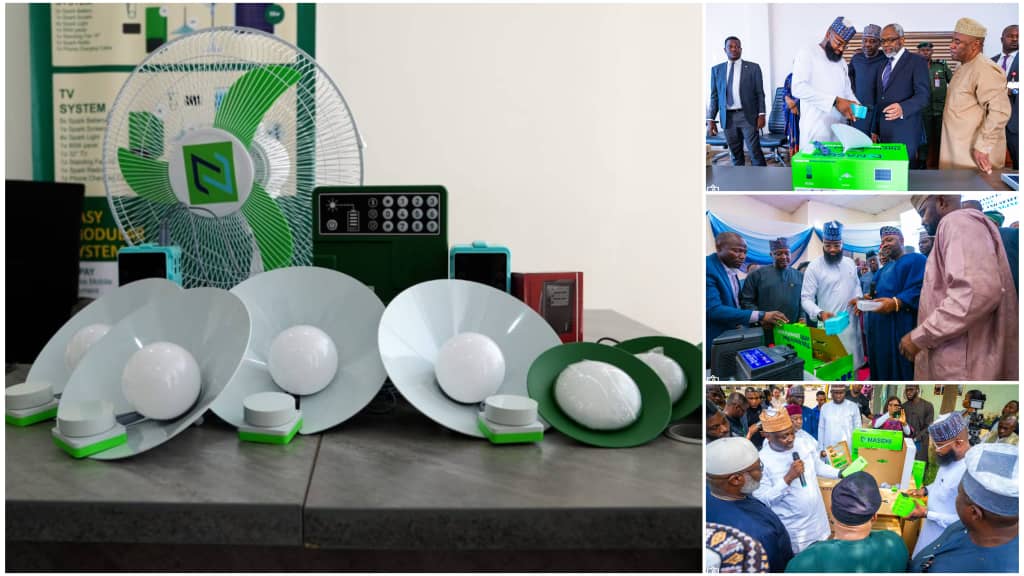
Under the Home Solar Solutions initiative, NASENI has introduced compact solar-powered systems designed specifically for households and small-scale users. These systems are built to provide basic electricity needs such as lighting, device charging and powering small appliances. Unlike large solar installations that require significant capital investment, the NASENI systems are designed to be affordable, portable and easy to install.
The basic NASENI Home Solar Unit features a battery capacity of 38 watt-hours supported by a 20-watt solar panel. The system is capable of powering LED lighting, charging mobile devices and operating a built-in radio. Once fully charged, the battery can provide up to seven hours of electricity after sunset.
Another variant of the Home Solar Solution includes a larger battery capacity of about 84 watt-hours and a 50-watt solar panel. In addition to lighting and charging functions, the upgraded system can power a small fan and other low-energy appliances. The lighting component of the system can last for more than 30 hours when fully charged, while the fan can operate for several hours, offering relief from heat at night.
The NASENI Home Solar Solution systems are designed to operate independently of the national grid, making them particularly useful in communities that lack access to electricity. Their compact design also allows them to be deployed quickly in remote areas without requiring extensive infrastructure.
According to the Executive Vice Chairman and Chief Executive Officer of NASENI, Khalil Suleiman Halilu, the Agency’s focus is on delivering practical technologies that respond directly to the everyday needs of Nigerians. He explained that the Home Solar Solution initiative forms part of the Agency’s broader strategy to drive technological innovation through what NASENI describes as the “3Cs” principle of Creation, Collaboration and Commercialisation.
“We are building systems that take into account our climate, our economic realities and our local supply chain,” Halilu said while highlighting the importance of developing technologies that are suited to Nigeria’s environment and economic conditions.
He further emphasised that partnerships between government institutions, private sector players and local communities remain essential to expanding access to renewable energy technologies. “This project perfectly embodies the 3Cs of NASENI. It is a partnership between government, local communities and agencies like NASENI to deliver solutions that improve the lives of Nigerians,” he said.
Beyond providing household energy systems, NASENI is also investing heavily in the development of a domestic renewable energy manufacturing ecosystem. The Agency operates solar manufacturing through its subsidiary, NASENI Solar Energy Limited (NSEL), located in Karshi, FCT, and has initiated several projects aimed at boosting Nigeria’s capacity to produce solar technologies locally.
Local manufacturing is a critical component of the Agency’s long-term strategy. By producing solar components domestically, NASENI hopes to reduce costs, stimulate industrial growth and create employment opportunities in the renewable energy sector.
Halilu has repeatedly stressed the enormous potential of renewable energy in Africa, noting that the continent’s abundant sunshine represents one of its greatest untapped resources. “There’s nothing that we have in abundance like the sun. The future is renewable energy,” he said while discussing the Agency’s plans to expand solar technology production in Nigeria.
Among the initiatives being pursued by NASENI is the development of a large renewable energy industrial park in Gora, Nasarawa State. The facility is expected to serve as a hub for solar technology manufacturing and renewable energy research, further strengthening Nigeria’s position in the emerging clean energy economy.
The affordability of NASENI’s Home Solar Solution is one of the key factors driving interest in the programme. Conventional solar installations available in the market often cost hundreds of thousands of naira, placing them beyond the reach of many households. NASENI’s approach is to provide smaller, modular systems that meet essential energy needs at a fraction of the cost.
For many families, this represents a significant shift in household energy economics. Instead of purchasing fuel regularly to run generators or buying kerosene for lamps, households can rely on solar energy generated during the day and stored in batteries for use at night.
The benefits extend beyond individual households. Small traders can keep their shops open after sunset, artisans can continue working despite grid outages, and rural entrepreneurs can operate businesses that depend on basic electricity.
In communities where the systems have already been introduced, the impact is becoming evident. Residents of Kawu Village in Bwari Area Council of the Federal Capital Territory, for example, have begun using the NASENI solar systems to power lighting and small appliances.
One resident, Mukailu Madaki, said the system has helped improve the living conditions of his family. “I bought this NASENI solar because of my children,” he said, explaining that the lighting provided by the system allows his children to study comfortably at night.
Such experiences highlight the broader social impact of affordable solar technology. For students in off-grid communities, access to lighting can improve educational outcomes. For families, the elimination of kerosene lamps reduces health risks associated with indoor air pollution.
NASENI’s solar initiative is designed to serve communities across Nigeria’s diverse settlement patterns. In rural areas, where grid expansion may take years, solar systems provide immediate access to electricity. In semi-urban communities with unstable power supply, the systems serve as reliable backup energy sources.
Even in urban centres where grid connectivity exists, many households are turning to solar technology to supplement erratic electricity supply. The Agency has also undertaken training programmes to build technical capacity for installing and maintaining solar systems across the country.
Through these programmes, NASENI aims to ensure that the technology can be deployed widely and supported by skilled technicians at the community level. The broader objective is to create an ecosystem in which renewable energy technologies are not only accessible but also sustainable in the long term.
As Nigeria continues to grapple with the challenges of electricity generation and distribution, initiatives such as NASENI Home Solar Solutions represent a practical pathway toward improving energy access. By combining indigenous technological development, local manufacturing and community-focused deployment strategies, the programme demonstrates how innovation can be harnessed to address one of the country’s most pressing development needs.
For millions of Nigerians who still live with unreliable electricity, the promise of affordable solar power through NASENI Home Solar Solution offers more than just light after sunset. It represents an opportunity to improve livelihoods, expand economic activity and bring the benefits of modern energy to communities that have long remained in the dark.
UPDATE NEWS: Nigerians can now invest ₦2.5 million on premium domains and profit about ₦17-₦25 million. All earnings paid in US Dollars. Rather than wonder, click here to find out how it works.
https://dailytrust.com/naseni-home-solar-solutions-bringing-affordable-energy-to-nigerians/