

Every few years, something strange drifts into our solar system. However, this object is not from the family of the Sun’s planets, asteroids, or comets. Instead, it comes from the vast darkness of space, traveling at tremendous velocities, carrying materials formed in a completely different planetary system.
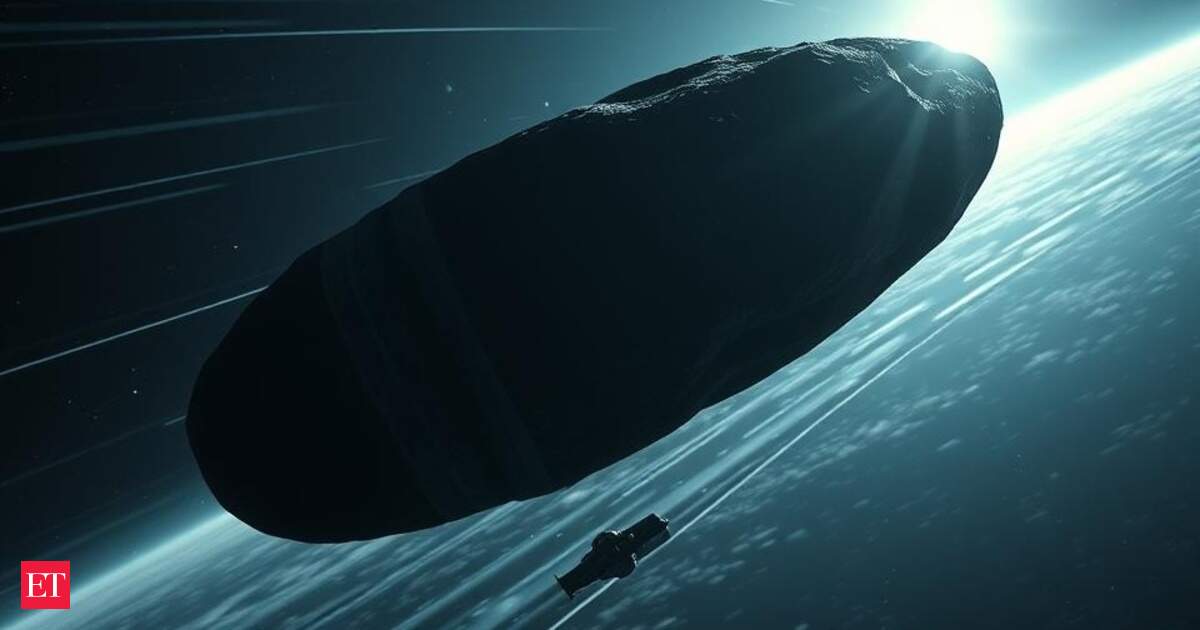
TIL Creatives I witness a colossal, icy asteroid hurtling through our solar system, dwarfing a lone spacecraft in a dramatic cosmic chase.
Astronomers refer to such objects as interstellar interlopers. They are, perhaps, the most scientifically valuable visitors humanity is ever likely to encounter. However, despite the importance of such events, there is still no coordinated global response mechanism to address them.
The entry of the interstellar visitor, named 3I/ATLAS, in 2025 underscored that responding to such events is simply impossible to ignore. This is because the visitor is the third confirmed visitor from outside the solar system, after the detection of the first two, namely, 1I/‘Oumuamua in 2017, followed by the detection of 2I/Borisov in 2019.
A Sudden Visitor From Another Star Astronomers detected 3I/ATLAS in July 2025 at a distance of about 670 million kilometers from Earth, moving at roughly 60 kilometers per second, according to reporting by the American Geophysical Union’s publication EOS. That velocity immediately signaled that the object did not originate in our solar system.
Unlike other interstellar objects discovered earlier, scientists were, to some extent, prepared for this phenomenon. Scientists on the research teams had already proposed special programs known as Director’s Discretionary programs, designed to enable astronomers to direct telescopes to newly discovered objects as soon as possible. Therefore, astronomers worldwide coordinated efforts to observe the object using telescopes spanning New Zealand to Europe, and the initial scientific findings were published in The Astrophysical Journal Letters within 84 hours of the discovery, as revealed by the EOS report.
As revealed by the report, the discovery of the object was not the work of individual research teams but rather the result of the whole world participating in a scientific readiness exercise conducted by the astronomy community.
However, the scientists were only able to observe the object from a distance and could not send any spacecraft to intercept it for closer examination.
The Missing “Response Team” The core issue is simple. When interstellar objects arrive, they move extremely fast and leave the solar system just as quickly. Scientists may only have a short window of weeks or months to study them.
Experts argue that humanity needs a permanent response system that can react immediately after detection. Researchers usually describe this system as having four major components: early detection networks, ready spacecraft interceptors, standardized scientific instruments, and autonomous navigation technologies capable of handling extreme speeds.
Future telescopes are expected to help with the first part of this problem. The Vera C. Rubin Observatory, scheduled to begin wide sky surveys around 2026, will scan massive portions of the sky repeatedly to identify unusual moving objects. A 2021 study published in Science Advances proposed algorithms that could flag potential interstellar objects earlier, giving scientists weeks instead of days to prepare missions.
But detection alone does not solve the challenge. Scientists also need spacecraft that can launch quickly enough to intercept these visitors before they escape the solar system.
The Case for Interceptor Missions One of the strongest advocates for proactive missions is Avi Loeb, who leads the Galileo Project. Loeb argues that waiting to design a mission after detection guarantees failure because the objects are already racing away.
“We need dedicated missions, interceptors ready to launch the moment a new interstellar object is spotted,” Loeb explained in an interview discussion hosted by Imaginary Talks. “If we wait, they are gone forever. Catching one up close would be worth the investment of billions. The return in knowledge could be infinite.”
One upcoming attempt to build such readiness is the Comet Interceptor, a mission planned by the European Space Agency for launch later this decade. Instead of targeting a specific object, the spacecraft will wait in solar orbit until scientists identify a suitable comet or interstellar visitor.
Why These Objects Feel So Unsettling Part of the fascination surrounding interstellar objects stems from both psychology and science. A 2018 study published in the journal hosted by the National Center for Biotechnology Information found that public reactions to the discovery of extraterrestrial life often combine excitement with anxiety, particularly when people feel humanity is unprepared.
Interstellar visitors tap into that same uncertainty. They arrive suddenly, come from unknown star systems, and disappear before scientists can fully examine them.
The mystery surrounding ‘Oumuamua, whose unusual acceleration sparked speculation about exotic explanations before natural outgassing models were confirmed, shows how quickly uncertainty can spread when observations are limited.
Planetary scientist David Grinspoon has argued that stronger international cooperation is essential for studying these objects. Coordinated scientific responses, similar to global climate research efforts, would help ensure that every available telescope and instrument contributes useful data.
Preparing for the Next Visitor Astronomers expect that these interstellar visitors may actually be much more common than previously thought. Once the Rubin Observatory is up and running, it is expected that dozens of these objects may be discovered each year, according to Science.
This possibility indicates that the present time may be merely the start of a new era of astronomy.
At present, however, humanity is still largely reactive. Scientists observe these objects as they speed through the solar system, gathering as much information as possible before the objects disappear once again into interstellar space.
A true response system, complete with detection systems, prepared spacecraft, and international coordination, could turn these fleeting encounters into detailed scientific missions. Until such time, each visitor from other stars will continue to bring excitement, along with a hint of curiosity.
When the next cosmic traveler arrives, will we finally be ready to meet it?
https://economictimes.indiatimes.com/news/international/us/interstellar-objects-keep-dropping-into-our-solar-system-why-are-we-still-unprepared/articleshow/129254335.cms