
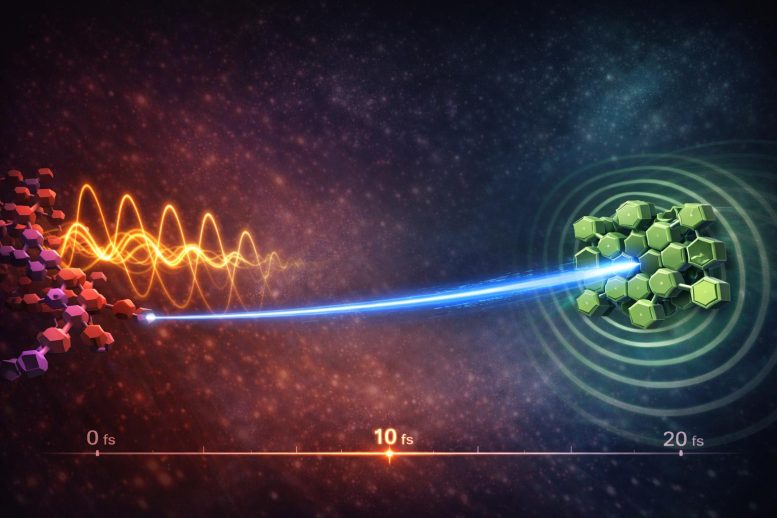
Artist’s illustration of the interplay of a vibrational mode in electron-transfer processes. Credit: Pratyush Ghosh
Scientists have discovered that electrons in solar materials can be launched across molecules almost as fast as nature allows, driven by tiny atomic vibrations.
Scientists have found that electrons can be propelled across solar materials at nearly the fastest speed allowed by nature, a discovery that challenges long-standing ideas about how solar energy systems function.
The finding could help researchers design better technologies for capturing sunlight and converting it into electricity.
In experiments that tracked events lasting only 18 femtoseconds – less than 20 quadrillionths of a second – scientists at the University of Cambridge observed electric charge separating during a single molecular vibration.
“We deliberately designed a system that, according to conventional theory, should not have transferred charge this fast,” said Dr. Pratyush Ghosh, Research Fellow, at St John’s College, Cambridge, and first author of the study. “By conventional design rules, this system should have been slow and that’s what makes the result so striking.
“Instead of drifting randomly, the electron is launched in one coherent burst. The vibration acts like a molecular catapult. The vibrations don’t just accompany the process, they actively drive it.”
Electrons Moving on the Timescale of Atomic Motion
A femtosecond is one quadrillionth of a second – one second contains roughly eight times more femtoseconds than all the hours that have passed since the universe began. At this extremely small timescale, atoms within molecules are constantly vibrating.
The researchers observed charge transfer occurring just as quickly as these atomic motions. As Ghosh explained, “We’re effectively watching electrons migrate on the same clock as the atoms themselves.”
The results, published in Nature Communications on March 5, 2026, challenge decades of assumptions in solar energy research. Scientists previously believed that extremely fast charge transfer required large energy differences between materials along with strong electronic coupling. However, these conditions can reduce efficiency by limiting voltage and increasing energy loss.
Dr. Pratyush Ghosh at the Cavendish Laboratory, University of Cambridge. Credit: Nordin Ćatić / St John’s College, Cambridge
How Light Creates Charge in Solar Materials
When light hits many carbon-based materials, it forms a tightly bound unit of energy known as an exciton – a paired electron and hole. For technologies such as solar cells, photodetectors, and photocatalytic systems to operate efficiently, this pair must quickly separate into free charges.
The faster this separation happens, the less energy is lost. This rapid splitting of charges plays a crucial role in determining how efficiently solar panels and other light-harvesting systems convert sunlight into useful energy.
To test whether this apparent trade-off was unavoidable, the Cambridge team purposely built a system expected to perform poorly. They placed a polymer donor next to a non-fullerene acceptor with almost no energy difference and very weak interaction – conditions that should have dramatically slowed the transfer of charge.
Instead, the electron crossed the boundary in just 18 femtoseconds. This speed is faster than many organic systems previously studied and occurs on the natural timescale of atomic motion. “Seeing it happen on this timescale within a single molecular vibration is extraordinary,” said Dr. Ghosh.
Molecular Vibrations Act as an Electron Catapult
Ultrafast laser experiments revealed what was happening. When the polymer absorbs light, it begins vibrating in specific high-frequency patterns.
These vibrations blend electronic states and effectively push the electron across the interface, producing directed ballistic motion rather than slow random diffusion.
When the electron reaches the acceptor molecule, it triggers a new coherent vibration. This signal is a rare indicator of such rapid charge transfer in organic materials. “That coherent vibration is a clear fingerprint of how fast and how cleanly the transfer occurs.
“Our results show that the ultimate speed of charge separation isn’t determined only by static electronic structure,” said Dr. Ghosh. “It depends on how molecules vibrate. That gives us a new design principle. In a way, this gives us a new rulebook. Instead of fighting molecular vibrations, we can learn how to use the right ones.”
A New Strategy for Solar and Light Harvesting Technologies
The findings point to a new approach for designing more efficient light-harvesting systems. Ultrafast charge separation is essential for technologies such as organic solar cells, photodetectors, and photocatalytic devices that can generate clean hydrogen fuel. Similar processes also occur in natural photosynthesis.
Professor Akshay Rao, Professor of Physics at the Cavendish Laboratory and former St John’s College Research Associate, who co-authored the study, said: “Instead of trying to suppress molecular motion, we can now design materials that use it – turning vibrations from a limitation into a tool.”
Reference: “Vibronically assisted sub-cycle charge transfer at a non-fullerene acceptor heterojunction” by Pratyush Ghosh, Jeroen Royakkers, Giacomo Londi, Samuele Giannini, Rakesh Arul, Alexander J. Gillett, Scott T. Keene, Szymon J. Zelewski, David Beljonne, Hugo Bronstein and Akshay Rao, 5 March 2026, Nature Communications.
DOI: 10.1038/s41467-026-70292-8
The research involved scientists from the Cavendish Laboratory and the Yusuf Hamied Department of Chemistry at the University of Cambridge, including Dr. Rakesh Arul, St John’s College Research Fellow, along with collaborators in Italy, Sweden, the United States, Poland, and Belgium.
Never miss a breakthrough: Join the SciTechDaily newsletter.
Follow us on Google and Google News.
https://scitechdaily.com/electrons-catapult-across-solar-materials-near-natures-speed-limit/