
Latest
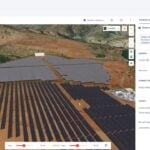
Evaluate 2.0 is the second generation of Solargis’ 3D PV power plant designer. Image: Solargis.
Slovakian software provider Solargis has launched Evaluate 2.0, the second generation of its 3D PV power plant designer, which combines high-resolution solar and meteorological data.
The cloud-based platform combines data from a number of sources to assist in the design of PV plants. These include meteorological data, based on a database of 30 years; ray tracing technology and the company’s own ground albedo data to better assess the effectiveness of bifacial modules in particular; and a ‘PV Component Catalog’ to provide an up-to-date profile of the latest components and technologies used in the sector.
This article requires Premium Subscription Basic (FREE) Subscription
Unlock unlimited access for 12 whole months of distinctive global analysis
Photovoltaics International is now included.
Regular insight and analysis of the industry’s biggest developments
In-depth interviews with the industry’s leading figures
Unlimited digital access to the PV Tech Power journal catalogue
Unlimited digital access to the Photovoltaics International journal catalogue
Access to more than 1,000 technical papers
Discounts on Solar Media’s portfolio of events, in-person and virtual
Or continue reading this article for free
The company argues that these features compare favourably to existing plant performance models in the industry, noting that the meteorological data contains “120 times the granularity” of current industry standard practices. Solargis products have been used to support the development and installation of over 10,000 projects, and Solargis CEO Marcel Suri exclusively told PV Tech this afternoon that this breadth and depth of data reflects a demand for a greater quantity and quality of data in the solar sector.
“You have geographical conditions, weather, technical design and then you have your business plan,” said Suri. “All those things need to talk, or be somehow considered when developing and designing projects. What we need to understand here is that because of the various technical nuances, you need to understand what is physically happening at a much higher level, [with] better granularity; hourly data does not give you information that is needed for agile operation of the power plant.”
Suri noted that Solargis’ use of collecting weather data in 15-minute increments is an improvement on the industry standard of one-hour increments, but that in future, even this may not be enough. He said that Solargis is aiming to deliver one-minute data increments in the future, to meet the solar industry’s continued need for more precise data.
This is not the first software programme to be launched in the solar sector in recent years; in October 2023, PVcase launched a programme to aid in the design of rooftop solar projects in particular, and in September 2024, researchers from Swansea University told PV Tech Premium that their agrivoltaics (agriPV) platform is part of the solar sector’s broader embrace of data and modelling in plant design and performance.
“Data collection and analysis is more important now than ever,” Swansea University PhD candidate Austin Kay told PV Tech Premium last year, highlighting the growing demand for data services – collection, assessment and utilisation – in the solar industry.
New data, new challenges
However, Suri told PV Tech that, even for a company with as long a history in data collection and management as Solargis, effectively managing the depths and details of data to be used in this way presents a challenge.
“I must say that with every single good idea, which comes very naturally – you don’t have to be a Nobel Prize winner to understand what is needed – there are so many details, which complicate your life,” said Suri. [Data] needs to be consistent geographically; you want to deliver the same quality data for, let’s say, Australia as well as the UK. You need to have time consistency; if I deliver data today, and data one year from now, it has to be consistent.
These challenges also range from the technical – such as finding ways to store vast quantities of information – to the logistical – such as collaborating with multiple partners, including engineering, procurement and construction (EPC) firms and project developers – all of which presents a breadth of questions for the solar sector to ask.
Yet Suri stressed that Solargis would look to tackle as many of these obstacles as possible. He concluded by saying that there is: “still a lot of work to do, to keep the pace”, to meet these challenges in data collection and deployment, but that: “we want to contribute here, and bring something that might bring the new value, that’s our ambition.”
Solar Media will host its annual Solar Finance & Investment Europe event in London on 4-5 February 2025. This event annually attracts infrastructure funds, institutional investors, asset managers, banks and development platforms at the forefront of European renewables; the vast majority of which are responsible for billions in active and prospective investments in the Europe’s energy transition. For more details, visit the website.
Returning in 2025 for its 12th edition, Solar Finance & Investment Europe Summit will bring together the brightest minds representing funds, banks, developers, utilities, government and industry across Europe and the UK on a programme that is solutions-focused from top to tail. The event is designed to enable leaders at the forefront of solar investment and deployment in Europe to scale, learn and land themselves industry defining partnerships.
FREE WEBINAR – Ahead of PV Tech’s flagship manufacturing event, PV CellTech, taking place in Frankfurt, Germany on 11-12 March 2025, this special webinar will evaluate the prospects for manufacturing wafers, cells and modules in Europe. What is stopping investments? Where are the green shoots likely to come from? How can the European PV sector successfully galvanise its established know-how in research and production equipment availability?
The webinar will feature contributions from some of the most promising manufacturing developments in Europe today, in addition to expert analysis and perspectives from the U.S. and what is needed to be put in place to stimulate new factory investments and manufacturing profitability.
The conference will gather the key stakeholders from PV manufacturing, equipment/materials, policy-making and strategy, capital equipment investment and all interested downstream channels and third-party entities. The goal is simple: to map out PV manufacturing out to 2030 and beyond.
Messe Stuttgart Stuttgart, Germany
Meet battery manufacturers, suppliers, engineers, thought leaders and decision-makers for a conference and battery tech expo focused on the latest developments in the advanced battery and automotive industries.
Stay plugged in for all the latest information on The Battery Show Europe 2024 including:
Keynote Speakers & Conference
Overview Show Features Floor Plan & Exhibitor
News Travel & Transport information
Understanding PV module supply to the European market in 2026. PV ModuleTech Europe 2025 is a two-day conference that tackles these challenges directly, with an agenda that addresses all aspects of module supplier selection; product availability, technology offerings, traceability of supply-chain, factory auditing, module testing and reliability, and company bankability.
data , europe , evaluate , forecasts , modelling , operations and maintenance , plant performance , sfieu , Slovakia , software , Solargis , weather
Read Next
Figures suggest that the European solar sector is seeing unprecedented levels of employment but the rate of new job creation is slowing.
December 2024 saw 2GW of power purchase agreements contracted in Europe, making it the second strongest month of the year for off-take deals.
The report from clean energy think tank Ember showed solar PV accounting for 11% of EU electricity while coal fell to historic lows of 10%.
Counties in Texas can expect to receive tax revenue of as much as US$18.8 million by locating a 100MW solar project on their land.
Belectric is set to build what it says will be both the largest PV project in the Netherlands and that the company has built in Europe.
TSE has raised €100 million (US$104.5 million) to support the development of seven new solar projects, with a combined capacity of 120MW.
Subscribe to Newsletter
Most Read
Features , Editors’ Blog , Interviews
Upcoming Events
Solar Media Events , Upcoming Webinars
https://www.pv-tech.org/better-granularity-solargis-launch-evaluate-2-0-programme/