

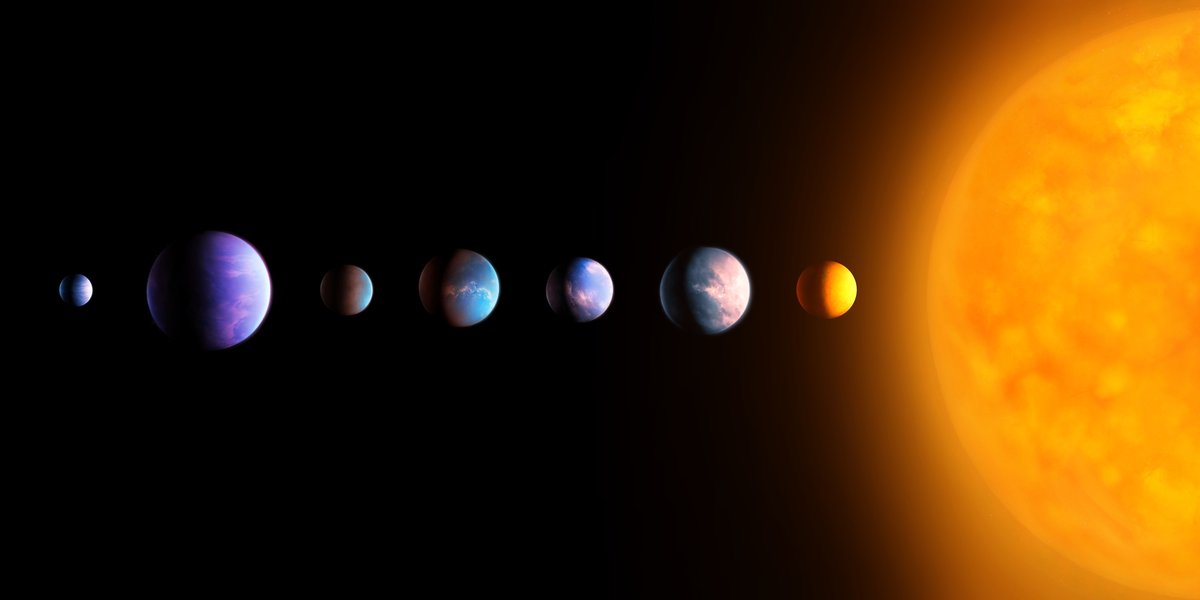
When I was a kid, I once watched a science-fiction flick called Journey to the Far Side of the Sun. The story’s main conceit was that scientists discover an Earth-like planet directly opposite our own in the same orbit around the sun, always hidden from our vantage point. The plot itself was somewhat silly, but the idea of a counter-Earth really stuck with me.
We know no such planet exists in real life, though; its gravitational effects on other worlds such as Mars and Venus would be obvious. Also, we’ve sent probes all through the solar system, and they’ve never spotted such a planetary arrangement.
But is this possible? Could two planets physically share the same orbit? The circumstances would have to be just right, and such a situation would be incredibly unlikely to occur. But the answer, surprisingly, is yes. In fact, many planets can technically share the same orbit! And when they do, their behavior gets pretty weird.
On supporting science journalism If you’re enjoying this article, consider supporting our award-winning journalism by subscribing. By purchasing a subscription you are helping to ensure the future of impactful stories about the discoveries and ideas shaping our world today.
The basic physics of how one object orbits another—say, a planet revolving around a star—has been known since Isaac Newton’s day. The math for such a simple system is pretty straightforward. And it’s deterministic; once you write down the equations, you can predict what the system will look like as far into the future or past as you like.
Throw in a third massive object, though, and the math gets ridiculously more complicated and difficult to solve. Under some circumstances, however, solutions exist that allow for a stable system even if two such planets interact. One of those solutions is a bit of weirdness called a horseshoe orbit, and it relies on a quirk of orbital mechanics.
Imagine that two planets orbit a star on very similar paths, but one (call it Planet 1) is just barely closer to the star than the other (Planet 2). This inner planet, being closer, will move more rapidly around the star than the outer planet. Eventually it will catch up to Planet 2. What happens next is counterintuitive: instead of smashing into each other, or one of them getting flung away on a high-speed slingshot trajectory, they will start to interact gravitationally while they are still hundreds of thousands of kilometers apart. Looking just at Planet 1 for a moment, it will be pulled ahead by Planet 2’s gravity, giving it more orbital energy.
This is where the oddity of orbital mechanics really factors in: if you give an object more energy (say, by accelerating it), it will naturally move to a higher orbit, one with a larger radius. So as Planet 1 accelerates, it moves slightly outward from the star. But objects in larger orbits move slower. Thus, Planet 1 slows down and begins to lag behind Planet 2, widening the gap between them. As seen from Planet 2, Planet 1 will appear to approach on the inside lane, slow down, move to the outside lane and then fall away once again. It’s as if Planet 2 has repelled its sister world! In reality, both objects orbit the star in the same direction, just at different, changing speeds.
But what about Planet 2? It’s affected by Planet 1’s gravity during the encounter as well. Planet 1 pulls Planet 2 backward, stealing some of the latter’s orbital energy. That drops Planet 2 into a smaller orbit, where it speeds up and moves ahead of Planet 1. So now Planet 1 is on the outside path, and Planet 2 on the inside. They’ve swapped orbits!
Eventually they meet again, and this time the roles are reversed: they swap orbits once more, and we’re back to the original situation.
This is not just theoretical; we see this happening in the solar system. Saturn has a pair of moons called Janus and Epimetheus, which orbit the planet on paths that are only 50 kilometers different in radius, and they undergo exactly this orbit swapping every four years or so. So not only does this occur in real life, but it’s actually a stable configuration.
That means two planets can indeed share (or nearly share) the same orbit. And while they will encounter each other, they can do so safely.
But what about an arrangement with more co-orbital planets, such as, say, three? Does that work?
According to research by a team of international scientists published in the Monthly Notices of the Royal Astronomical Society (MNRAS), yes, you can have more than two planets share an orbit. Astonishingly, many more can coexist!
First, the researchers used the mathematics of orbital mechanics to simulate the physics of two Earth-sized planets orbiting a sunlike star at 150 million kilometers (the real life Earth-sun distance) and showed they can persist in such horseshoe orbits for billions of years! Then the team added more and more planets to see what would happen.
When two planets meet up with each other, they swap orbits, as is already understood. But eventually one will then approach the third planet. When it does, they swap orbits and move apart. Eventually one of those two meets up with the first planet, and the whole situation repeats. This happens with every planet-on-planet encounter.
Incredibly, the scientists found this to be true if they had as many as 24 Earth-sized planets packed into a single orbit! Twenty-four! That shocked me. Still, it seems to work in the simulations; any planet can’t get very far along its path without meeting another, and when the two do so, they swap positions and continue on until the next encounter with the next planet down the line, constantly sliding around and jockeying for position.
The scientists even tried this in a simulation of our own solar system, which, they found, could support the addition of an extra couple of Earths or Venuses—or another Mercury or Mars.
Creating a system like this isn’t easy. It’s possible that a very thick ring of dust around a star could form several planets in the same orbit simultaneously, though conditions would have to be rather fine-tuned to allow that to happen. Also, planets can migrate toward and away from their host star on much grander scales as they interact gravitationally. And if enough smaller planets get tossed around by this process, they could also end up in shared orbits.
Detecting such planetary systems from Earth is possible, too. One way we find planets now is through the transit method, in which a planet passing directly in front of its star creates a mini eclipse, as seen from Earth. If several transits occur in sequence when we should only see one for that particular orbit, that would be a sign. Also, the fact that planets in this arrangement slide along their orbit and swap positions means that their positions in that orbit change, which, in turn, changes the timing of the transits. That would be detectable, too, even if all of the planets don’t actually join the transit parade.
Delightfully, the authors of the MNRAS study speculate that there is another way to form these systems: building them on purpose. Having multiple worlds all in one orbit might be handy for interplanetary travel. And while moving them around physically is a daunting task, a sufficiently technologically advanced alien civilization might feel that it’s worth the effort. If we ever were to find such a system, well, that would be interesting, wouldn’t it?
What a way to discover aliens exist! And it would really make me reassess my opinion on Journey to the Far Side of the Sun—possibly
https://www.scientificamerican.com/article/how-many-planets-could-fit-in-the-solar-system/