
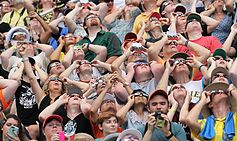
Watching the eclipse with the naked eye can cause permanent damage. 09:05, Mon, Aug 10, 2026 Updated: 09:06, Mon, Aug 10, 2026
People in the UK will be able to see a partial solar eclipse. (Image: Getty)
Brits will be in with the chance of witnessing a rare partial solar eclipse on Wednesday, but experts have warned of its dangers. The Moon will move between the Sun and Earth, blocking its light and casting a small shadow on Earth for just under two hours in the evening.
This year marks the greatest coverage visible from the UK since 1999, according to Royal Museums Greenwich, with around 90% of the Sun covered by the Moon for people watching from London. The Moon will begin to cover the edge of the Sun, known as first contact, at 8.17pm for people in England’s capital, before reaching its maximum at around 7.12pm and finishing at 8.06pm – depending on which areas you are.
Get the latest science news from the natural world, health, tech and beyond and more Invalid email
We use your sign-up to provide content in ways you’ve consented to and to improve our understanding of you. This may include adverts from us and 3rd parties based on our understanding. You can unsubscribe at any time. Read our Privacy Policy
Special glasses are required to protect the eyes. (Image: Getty)
During this time, any lucky viewers must take proper safety precautions, as looking at an eclipse with the naked eye can cause damage.
Bright rays from the Sun can burn the cells in the retina at the back of the eye, and the retina doesn’t have pain receptors, so the damage isn’t felt as it happens.
This can result in vision loss or blurry spots that may become permanent. To avoid this, it’s recommended to wear a pair of ISO 12312-2 certified eclipse glasses, as they only allow a small amount of light to pass through.
Regular sunglasses are not good enough as they don’t block enough light and therefore can still cause permanent eye damage.
Legitimate eclipse glasses will have the safety certification “ISO 12312-2” or “ISO 12312-2:2015” printed somewhere on them.
Eclipse glasses work by only letting a small amount of light through. (Image: Getty)
Pinhole projectors also allow for safe viewing indirectly through a projection of the event. Royal Museums Greenwich provides instructions on how to make one using a cardboard box, white paper, foil, and a pin.
Another affordable and accessible way to safely enjoy the eclipse is through colanders and tea strainers, which also work in a similar way; by holding them up and looking at the shadow they cast, multiple projected images of the eclipse are visible.
Imo Bell, a planetarium astronomer at the Royal Greenwich Observatory, told the Press Association: “Its not a total eclipse, but over 90% is really exciting. Were not going to get one this good for a really long time.
“So its important not to miss it, and to be prepared. You cant just go out and expect to have a look because its really dangerous for your eyes.
Not wearing eclipse glasses can cause permanent eye damage. (Image: Getty)
“So you can use solar eclipse glasses, which are very, very different from sunglasses they block out so much light that you cant see anything through them except the Sun, because thats how much light they need to block for the damaging light of the Sun to be safe to view.
“Ideally a solar telescope is an amazing way to witness it, and if you dont have one of them then you can look into whether your local astronomy society is doing any events.
“And if all else fails, you can project the image of the eclipse using a household item like a colander which has lots of holes in point the colander towards the Sun with your back facing it, and in the shadow of the colander youll be able to see the eclipse in the holes, which is really cool.”
https://www.express.co.uk/news/science/2237581/solar-eclipse-glasses-how-to-watch-safely