
The technology represents an advancement in addressing the labour-intensive and hazardous nature of manual solar PV power plant maintenance.
“Hotspots decrease the efficiency of a PV panel over time, because of the electrical and thermal imbalance they cause within the module,” said Kenrick Anderson, senior photovoltaic scientist at CSIRO.
“If solar farms cost less to run, and can be more consistent in their energy output, this increases the stability of the grid.”
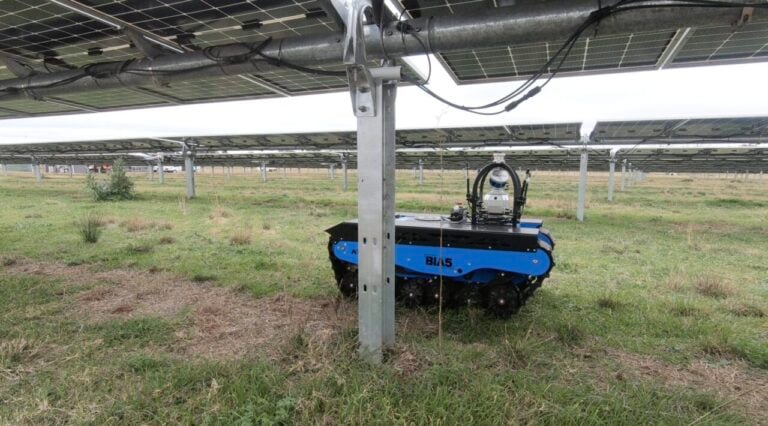
The robotic platform integrates multiple sensor technologies, including Light Detection and Ranging (LiDAR) for precise 3D environmental mapping, RGB cameras for visual inspection, and thermal infrared cameras designed to detect electrical faults and thermal anomalies.
This comprehensive sensor suite enables the detection of various maintenance issues, including dust accumulation, physical damage, loose hardware components, and critical electrical hotspots, which can significantly impact modules performance.
Addressing industry-wide maintenance challenges
The deployment addresses fundamental challenges facing Australia’s solar sector, where large-scale installations generating upwards of 500MW require extensive manual inspection regimes.
Traditional maintenance approaches involve personnel conducting lengthy foot patrols across thousands of kilometres of often harsh terrain, presenting significant safety risks and operational costs.
The autonomous system’s ability to operate continuously across diverse environmental conditions while building detailed digital maps of site infrastructure represents a substantial operational advancement.
The technology automatically catalogues maintenance requirements and creates comprehensive data records for each inspection cycle.
“We are not just collecting images or 3D data. We are building the foundations for intelligent solar operations, where data from robots, fixed sensors and field systems can be combined,” explained Dr Peyman Moghadam, senior principal research scientist at CSIRO.
“This supports better proactive maintenance decisions and more resilient performance over time.”
The development aligns with broader industry trends toward automation in solar operations, following successful deployments of AI-powered robot installers that have exceeded targets at major Australian projects.
The maintenance-focused application represents a natural evolution of robotic applications across the solar value chain.
Commercial deployment pathway
CSIRO’s approach emphasises transforming regional employment rather than simply displacing jobs. The technology is designed to shift workforce focus from repetitive manual inspection tasks toward higher-skilled technical roles in robotics support, data analysis, and targeted maintenance interventions.
“It’s good to fulfil a need in areas of the country where the labour is not attainable or reliably available,” noted Ross Dungavell, senior robotics engineer at CSIRO.
“Often, you cannot get someone to go out there under such harsh conditions, for extended periods of time. The robot logs and stores every piece of data it captures; its sensors are able to find any fault a panel might have.”
The research organisation confirmed it is actively pursuing industry partnerships to accelerate the commercial deployment of the technology across Australia’s solar sector.
https://www.pv-tech.org/csiros-thermal-sensing-robots-detect-solar-module-faults-in-landmark-australian-trial/