
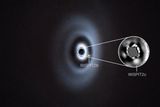
Two giant planets are actively forming around a young star at the same time, something astronomers have only observed once before. Known as WISPIT 2, the system provides a direct look at how planetary systems come together, including our own billions of years ago.
The discovery, published in The Astrophysical Journal Letters, builds on earlier observations of a single newborn planet. Now, using telescopes from the European Southern Observatory (ESO), researchers have confirmed a second planet embedded within the same disc of gas and dust.
“WISPIT 2 is the best look into our own past that we have to date,” said Chloe Lawlor, lead author of the study, in a press release.
Inside Planet Formation in WISPIT 2 Catching planets in the act of forming is notoriously difficult. These worlds emerge within dense discs of material around young stars, often hidden from view. So far, only one other system — PDS 70 — has provided evidence of multiple planets forming at once.
WISPIT 2 now joins that short list, but with a difference. Its disc stretches much farther out and is etched with distinct gaps and rings, signs that growing planets are reshaping their surroundings. Unlike PDS 70, this wider disc reveals how planet formation can unfold across a much larger region of a single system.
“These structures suggest that more planets are currently forming, which we will eventually detect,” Lawlor said.
The first planet discovered in the system, WISPIT 2b, is a gas giant nearly five times the mass of Jupiter, orbiting far from its star. The newly confirmed planet, WISPIT 2c, lies much closer in and is even more massive, highlighting how giant planets can form at very different distances as a system evolves.
To confirm the second planet, researchers combined imaging from the VLT’s SPHERE instrument with data from the GRAVITY+ instrument on the VLT Interferometer. Together, these tools allowed them to detect the faint signal of a planet forming much closer to its star than previously possible.
How Young Planets Shape Their Birthplace The disc around WISPIT 2 isn’t static; it’s constantly being reshaped by growing planets. As planets grow, their gravity pulls in surrounding material, carving out gaps along their orbits. Over time, particles clump together, forming “embryo” planets that continue to gather mass while sweeping up dust and gas. This process leaves behind defined edges that make the rings and gaps visible to telescopes.
“WISPIT 2 gives us a critical laboratory not just to observe the formation of a single planet but an entire planetary system,” said Christian Ginski, study co-author, in the press release.
These observations help researchers test long-standing ideas about how planets grow from small clumps of dust into massive gas giants.
Read More: JWST Peers Into the Haze Surrounding an Unusual Cotton Candy-Like Planet
A Possible Third Planet The system may hold more than two planets. Researchers have identified another, narrower gap farther out in the disc.
“We suspect there may be a third planet carving out this gap,” said Lawlor, “potentially of Saturn mass owing to the gap’s being much narrower and shallower.”
That outer gap follows the same pattern seen closer to the star, where growing planets carve out paths as they gather material. Its narrower shape suggests the potential planet may be smaller, adding to the picture of a system forming multiple worlds at different scales.
Confirming the presence of a third planet will require more powerful instruments. Future observations with ESO’s Extremely Large Telescope may be able to directly image smaller, fainter worlds still taking shape.
Read More: JWST Identifies a New Class of Planet With Deep Magma Oceans — Which is Unlike Anything in our Solar System
Article Sources Our writers at Discovermagazine.com use peer-reviewed studies and high-quality sources for our articles, and our editors review for scientific accuracy and editorial standards. Review the sources used below for this article:
This article references information from a recent study published in The Astrophysical Journal Letters: Direct Spectroscopic Confirmation of the Young Embedded Protoplanet WISPIT 2c
https://www.discovermagazine.com/two-planets-forming-around-a-young-star-could-resemble-an-early-solar-system-48862