
By Michael Kern – Nov 20, 2025, 2:00 PM CST
The global floating solar panels (FPV) market is projected to grow from $55.11 million in 2024 to $84.90 million by 2032, driven by increasing land scarcity and government renewable energy mandates.
Installing solar panels on water bodies provides a critical technical advantage, with the natural cooling effect boosting solar panel efficiency by an estimated nine percent.
The market is dominated by the stationary floating panel segment (over 82% of revenue in 2024) and onshore water body installations (nearly 90%), with the Asia-Pacific region leading global deployment.
The global floating solar panels market is projected to grow significantly over the next seven years, driven by increasing land scarcity, government mandates for renewable energy, and the technology’s inherent efficiency benefits, according to a report from market research firm DataM Intelligence.
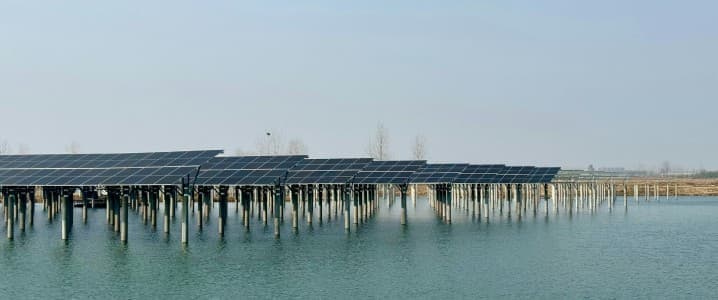
The market, valued at $55.11 million in 2024, is forecast to increase to $84.90 million by 2032, expanding at a compound annual growth rate (CAGR) of 5.55% from 2025 to 2032. This growth signals a shift in the solar industry, where floating photovoltaic (FPV) systems, often called “floatovoltaics,” are moving from a niche application to a key component of national decarbonization strategies in regions with limited available land.
Challenges Facing Floating Solar Adaption Floating solar technology addresses two core challenges facing large-scale solar deployment: competition for land and the demand for higher energy yields. Installing solar panels on man-made water bodies, such as reservoirs, hydroelectric dams, and industrial ponds, avoids conflicts with agriculture or urban development.
The aquatic environment provides a critical technical advantage. The natural cooling effect of the water can boost solar panel efficiency by an estimated nine percent compared to ground-mounted installations, according to DataM Intelligence. Furthermore, covering water bodies can reduce evaporation, offering a dual benefit particularly valuable in arid or water-stressed regions.
The industry has seen accelerated adoption, with more than 1.8 gigawatts (GW) of floating solar capacity added globally in 2024 alone, marking the largest annual addition to date. Governments in the United States, Japan, South Korea, China, India, and parts of Europe are prioritizing this technology to meet renewable energ y targets and enhance grid stability, especially in urban or densely populated areas.
The Tech Driving the Boom The stationary floating solar panel segment dominated the market in 2024, capturing over 82% of the total revenue, or approximately $45.19 million. These systems are favored for their lower installation costs and simpler anchoring requirements, making them suitable for utility-scale projects such as the 320-megawatt Dezhou plant in China.
Conversely, tracking floating solar panels, which adjust their tilt to follow the sun and can increase energy output by 18%, accounted for the remaining 18% of the market. While offering higher yields, their mechanical complexity and increased maintenance requirements typically limit deployment to stable inland water bodies.
Location-wise, onshore water bodies—reservoirs, lakes, and dams—comprised nearly 90% of the market in 2024, generating $49.6 million. These locations provide stable anchoring conditions and easier maintenance access. Offshore floating solar remains an emerging but fast-growing segment, accounting for 10% of the market. This segment, though facing challenges like corrosion and high waves, is gaining traction in Singapore and the Netherlands as countries with extreme land constraints explore deep-water solar farming.
In terms of technology, photovoltaic (PV) modules overwhelmingly dominated the market, contributing more than 95% of total revenue. Crystalline silicon PV remains the established standard due to its high efficiency and cost-effectiveness for water-based positioning.
Who is Leading the Race? The Asia-Pacific region continues to lead the global deployment of floating solar, with Japan and China being early adopters.
Japan commanded approximately 14% of the global market revenue in 2024, equivalent to $7.7 million. The country’s severe land scarcity and supportive government policies have made FPV an ideal expansion model, with more than seventy megawatts of new capacity registered over the last twelve months, according to the report. The United States market contributed an estimated $6.4 million in 2024, capturing 11.6% of the global market share. Growth is primarily driven by state-level initiatives, particularly in California and Florida, where utilities are integrating floating solar with water treatment facilities. Federal incentives, such as the Inflation Reduction Act, are also accelerating the expansion of hybrid floating solar and battery storage models. Competition is led by specialized floating platform providers and major solar manufacturers. The top five companies—Ciel & Terre International, Trina Solar, JA Solar, Kyocera Corporation, and LONGi Green Energy Technology—collectively held 64% of the global floating solar panel market share in 2024. Ciel & Terre remains the market leader, having completed over 1.2 GW of installations worldwide.
The strategic outlook suggests floating solar is transitioning into commercial maturity with structured investments from utilities and independent power producers. Future growth is expected to center on the wider deployment of hybrid systems that combine floating solar with existing hydropower and battery storage solutions to enhance grid reliability and energy availability.
By Michael Kern for Oilprice.com
More Top Reads From Oilprice.com
Exxon to Buy Stake in Enterprise’s New Permian NGL Pipeline Russian Attacks Cripple Ukraine’s Nuclear Power Output Geothermal Energy Poised to Nearly Double in Value by 2034
Download The Free Oilprice App Today
Back to homepage
Michael Kern
Michael Kern is a newswriter and editor at Safehaven.com and Oilprice.com,
More Info
Related posts
Leave a comment
https://oilprice.com/Alternative-Energy/Solar-Energy/Asia-Pacific-Is-Leading-the-Global-Floating-Solar-Panel-Boom.html